Labels

Lifestyle (300) Investing (299) Entertainment (241) Singapore (161) Rewards (112) Technology (112) Equities (85) Gaming (73) AI (69) U.S. (67) Crypto (55) Food (55) Portfolio (52) Data (46) Travel (43) Sports (38) News (35) Insights (33) Movies (33) Savings (33) Credit Card (31) Policies (24) Shows (23) Holidays (21) Earnings (18) Tennis (17) Bonds (12) Football (12) Promotions (12) World (12) REITs (10) Referral (10) Toys (8) Anime (6) Apps (6) Cash Management (6) Healthcare (6) Property (6) China (5) ETFs (5) Security (5) DeFi (4) Retirement (4) T-Bills (4) Robotics (3) Shopping (3) Blog (2) Cashback (2) Insurance (2) Japan (2) Malaysia (2) Reviews (2) Robo-Advisor (2) 1-For-1 (1) Asia (1) Australia (1) CPF (1) Commodities (1) Currency (1) Funds Management (1) Futuristic (1) Inflation (1) Miles (1) Nerfs (1) SGD (1) Social (1) Weird (1)

Friday, 26 December 2025

Investing Updates: Has Singapore’s stablecoin surge peaked, or is 2026 just the start?


Source:


ChatGPT:


Stablecoins surged globally in 2025, and Singapore has emerged as a leading hub rather than a late adopter. Singapore dollar-backed stablecoin XSGD grew to about S$17 million in market capitalisation by December, up from S$10 million a year earlier. While modest in absolute terms, this growth reflects strong institutional confidence driven by regulatory clarity rather than retail speculation.

A key advantage is Singapore’s early regulatory groundwork. The Monetary Authority of Singapore (MAS) finalised its Single-Currency Stablecoin (SCS) framework in 2023, ahead of similar moves in the US such as the Genius Act. This proactive stance has positioned Singapore as a global benchmark for crypto regulation, earning top ranking for regulatory clarity in Bybit’s 2025 World Crypto Rankings. Industry leaders from Coinbase, Crypto.com and Ryder credit MAS for evolving regulation without chasing hype, attracting serious builders and institutional players.

Globally, stablecoins are a US$300 billion market today and could reach US$4 trillion by 2030 in a bullish scenario. Singapore aims not to dominate issuance, but to become Asia’s most trusted institutional hub for compliant stablecoins. Initiatives such as Project Orchid and the newly announced BLOOM framework signal a shift from experimentation toward real-world settlement using tokenised bank liabilities and regulated stablecoins. Industry leaders expect 2026 to see broader commercial deployment across banks, asset managers and payment systems.

However, challenges remain. Over 98% of global stablecoin value is still US dollar-denominated, creating concentration risk and dependence on US monetary policy. Developing liquid, trusted local-currency alternatives like XSGD will take time. Fragmentation is another concern, with users potentially holding multiple stablecoins; this may be solved through “invisible” software that abstracts complexity.

Looking ahead, growth is likely to come from institutional use cases such as tokenised payables, supply-chain finance and cross-border settlement. The ultimate sign of success in 2026 will be when users benefit from faster, cheaper transactions—without even realising they are using stablecoins at all.

Wednesday, 24 December 2025

Travel Updates: Review: Electric Train Service (ETS) from Johor to Kuala Lumpur


Source:


ChatGPT:


The long-awaited direct Electric Train Service (ETS) between Johor Bahru’s JB Sentral and Kuala Lumpur’s KL Sentral officially launched in December 2025, restoring a convenient rail link between Malaysia’s two largest cities after years of disruptions and indirect routes. The service became possible following the completion of the Electrified Double Tracking Project (EDTP) between Kluang and JB Sentral, eliminating the need for train changes at Gemas.

The JB–KL route operates as an ETS Platinum service, using the new ETS3 (KTM Class 94) electric trains, capable of speeds up to 140 km/h. The journey includes multiple stops across Johor and Negeri Sembilan before reaching KL Sentral. One-way fares start from around MYR80–87 for Standard Class and MYR150–160 for Business Class.

Standard Class offers a comfortable 2-2 seating layout with power sockets, USB ports, tray tables and adequate legroom. Business Class, located in a dedicated car, features a 1-2 layout, generous legroom, seat recline, personal power outlets and a touch-screen entertainment system. Business Class passengers receive a complimentary hot meal, drinks and snacks, though food quality is modest and onboard Wi-Fi and entertainment connectivity were unreliable during the journey.

The ride is generally smooth and quiet, with scenic views along much of the route. However, delays occur north of Seremban due to ongoing single-track works under the Klang Valley Double Track Phase 2 project, slowing the final stretch into Kuala Lumpur. Despite this, the train arrived only slightly behind schedule.

Overall, the new ETS offers a jam-free, predictable and competitively priced alternative to buses and flights. While further infrastructure upgrades and the future RTS Link will enhance the experience, the ETS already stands out as a practical and appealing option for Singapore–Johor–Kuala Lumpur travel.

Rewards Updates: Awesome: HeyMax Card Maximiser now supports UOB Preferred Platinum Visa & UOB Visa Signature


Source:


ChatGPT:


The HeyMax Card Maximiser has added support for two popular UOB Visa miles cards — the UOB Preferred Platinum Visa (PPV) and UOB Visa Signature — making it easier to track their bonus caps and minimum spend requirements automatically through the app. Previously, these cards were among the simplest for earning 4 miles per dollar (mpd) on eligible spend, but recent changes such as bonus sub-caps introduced complexity in maximising rewards, requiring manual tracking of how much spend has been allocated to each bonus category.

Once linked, the Card Maximiser will monitor transactions going forward (it cannot retroactively access spend prior to linking). For the UOB Preferred Platinum Visa, this means tracking the S$600 calendar-month bonus caps for mobile contactless and selected online transactions that earn 4 mpd, helping users avoid overshooting or undershooting bonus thresholds.

For the UOB Visa Signature, the Maximiser tracks its statement-month bonus caps and minimum spend of S$1,000 per category, such as contactless & petrol and foreign currency, which both have S$1,200 caps at 4 mpd once conditions are met. Users must input their statement cycle end date so the app knows when to reset these caps.

The ability to automatically tally both bonus caps and minimum spends removes much of the manual effort that previously made optimising these cards fiddly and error-prone. While earlier workarounds — such as juggling supplementary cards — existed, the article notes that having direct support in HeyMax is a significant improvement that will reduce mistakes and save time for cardholders hunting miles.

In short, HeyMax’s update streamlines reward tracking for two widely used UOB Visa cards, helping users maximise their 4 mpd earning potential with less hassle.

Tuesday, 23 December 2025

Sports Updates: Fifa to use cooling breaks at every World Cup 2026 game, regardless of weather


Source:


ChatGPT:


Fifa has announced that mandatory cooling and hydration breaks will be implemented in every match at the 2026 World Cup, regardless of weather conditions, venue location or stadium design. Under the new rule, referees will stop play 22 minutes into each half to allow players a three-minute hydration break, effectively dividing matches into four segments or “quarters”.

Previously, cooling breaks were only mandated when temperatures exceeded a specific heat threshold, measured using the wet bulb global temperature system. Fifa described the new approach as a “streamlined and simplified” version of the earlier policy, removing the need to assess conditions on a game-by-game basis. The organisation said the decision was made primarily in the interest of player safety, particularly following concerns over heat and humidity during recent tournaments.

The move follows this year’s Club World Cup in the United States, where extreme heat prompted Fifa to lower the threshold for water breaks and introduce additional measures such as placing water and towels around the pitch. Heat has been a recurring issue at major football events, including the 2014 World Cup in Brazil, where courts intervened to make breaks mandatory amid health concerns.

Fifa acknowledged that referees may apply limited flexibility if an injury or stoppage occurs shortly before the scheduled break, with decisions made on the spot.

Beyond player welfare, the change may also benefit broadcasters, as the predictable timing of breaks allows for more structured coverage and potential advertising opportunities. Some observers note that the format resembles quarter-based stoppages common in major US sports leagues such as the NFL and NBA.

A recent report highlighted the relevance of the policy, finding that 10 of the 16 World Cup venues across the US, Canada and Mexico face very high risks of extreme heat stress, underscoring the need for consistent protective measures during the tournament.

Rewards Updates: Which credit card covers the most bonus MCCs?


Source:


ChatGPT:


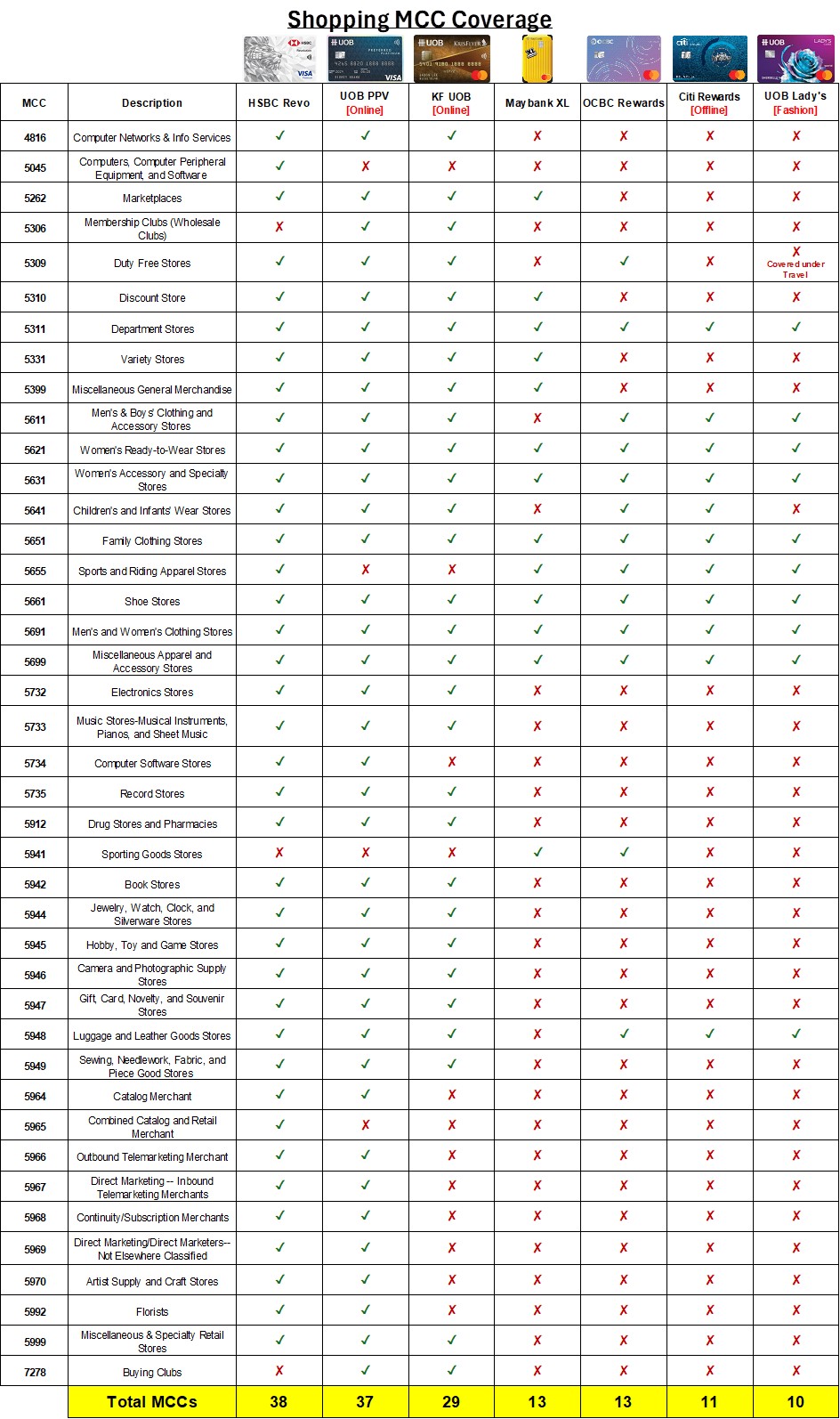
Choosing a credit card with the widest range of bonus merchant category codes (MCCs) can significantly increase rewards, especially for users who rely on whitelist cards that award bonuses based on spending categories rather than payment mode. While blacklist cards like the UOB Preferred Platinum Visa (PPV) and Citi Rewards Card are popular for their simplicity, their bonus caps mean most users still need whitelist cards to maximise rewards.

Among popular rewards cards in Singapore, the UOB Preferred Platinum Visa leads with 54 bonus MCCs, followed closely by the HSBC Revolution with 51 MCCs, both offering up to 4 miles per dollar (mpd). Other notable cards include the KrisFlyer UOB Credit Card (33 MCCs, 2.4 mpd with no cap but conditions), Maybank XL Rewards (27 MCCs), and UOB Lady’s Solitaire, whose coverage varies based on selected categories. While Citi Rewards and UOB PPV are often viewed as blacklist cards, they switch to whitelist mode depending on how spending is made.

MCC quantity alone does not determine usefulness. Some cards, such as the OCBC Rewards and KrisFlyer UOB Credit Card, also award bonuses based on merchant names rather than MCCs, improving real-world usability. The article also highlights how MCC “switching” via gift card platforms like HeyMax (MCC 5311) and Wogi (MCC 5947) can unlock bonus rewards across dining, shopping, travel and entertainment, making these MCCs particularly valuable.

By category, UOB PPV offers the widest dining and entertainment coverage, while HSBC Revolution excels in shopping and travel, though its travel bonuses are currently time-limited. For transport, the UOB Lady’s Card provides the broadest coverage when configured appropriately.

Ultimately, the article concludes that HSBC Revolution and UOB Preferred Platinum Visa offer the broadest MCC coverage overall, but emphasises that quality of MCCs matters more than quantity. Cardholders should analyse their own spending patterns and prioritise cards that cover the most useful MCCs for their lifestyle.

LifeStyle Updates: Singapore’s core, headline inflation hold steady at 1.2% in November


Source:


ChatGPT:


Singapore’s core and headline inflation remained unchanged at 1.2% year on year in November, according to the Monetary Authority of Singapore (MAS) and the Ministry of Trade and Industry (MTI). Both readings came in slightly below market expectations of 1.3%, reinforcing signs that inflation pressures remain contained.

Core inflation, which excludes accommodation and private transport, was steady as higher services inflation was offset by weaker retail and other goods prices, alongside a sharper fall in electricity and gas costs. On a month-on-month basis, core prices edged down 0.1%, while the all-items consumer price index rose 0.2%.

Headline inflation also held at 1.2%, reflecting unchanged accommodation and core inflation. Accommodation costs continued to rise modestly at 0.3%, in line with stable rental growth. Food inflation was unchanged at 1.2%, as prices for both cooked and non-cooked food rose at the same pace as in October.

Across CPI categories, price movements were mixed. Private transport inflation eased to 3.5%, down from 3.8%, due to a smaller increase in car prices. Retail and other goods inflation dipped to 0.3% as clothing, footwear and personal care appliance prices fell. Electricity and gas prices declined more sharply by 4.1%, reflecting lower electricity costs.

The main upward pressure came from services inflation, which rose to 1.9% from 1.8% in October, driven by higher costs for point-to-point transport services and health insurance.

MAS and MTI maintained their full-year 2025 forecasts, projecting core inflation at 0.5% and headline inflation at 0.5% to 1%. Forecasts for 2026 were also unchanged at 0.5% to 1.5% for both measures. Authorities highlighted ongoing uncertainties, noting that while imported cost pressures are easing, supply shocks or weaker global demand could alter the inflation outlook.

Monday, 22 December 2025

Food Updates: Less sugar, same punch? Sabah’s red durians take centre stage in tourism push


Source:


Investing Updates: What to Expect in the Week Ahead (Christmas Holiday, Q3 GDP Growth and CB Consumer Confidence)


Source:


ChatGPT:


U.S. markets head into Christmas week on a relatively calm note, following a volatile but ultimately steady stretch in equities. Stocks rose on Friday, supported by gains in Oracle as enthusiasm around artificial intelligence rebounded after recent turbulence. With the Q3 earnings season concluded and the holiday period beginning, trading activity is expected to be lighter, while attention shifts toward macroeconomic signals and longer-term policy considerations, including speculation around the next Federal Reserve chair.

Christmas week is typically quiet for U.S. markets. Stock exchanges will close early on December 24 and remain shut on December 25. The key economic focus falls on Tuesday, December 23, when several important data releases are scheduled. These include durable goods orders, the second estimate of third-quarter GDP growth, and the Conference Board’s consumer confidence reading. Economists expect the GDP revision to confirm a solid 3.2% annualized expansion in Q3, reinforcing the view that the U.S. economy remains resilient. Durable goods orders for October are forecast to rise 0.4%, offering insight into business investment trends, while consumer confidence will shed light on household sentiment heading into year-end.

Market performance last week was largely mixed. The Dow Jones Industrial Average declined 0.67%, while the S&P 500 edged up 0.1% and the Nasdaq Composite gained 0.48%. Trading activity was concentrated in well-known names such as Nvidia, Tesla, Oracle, Broadcom, Palantir, Micron Technology, Nike, and Rocket Lab.

Among notable movers, Rocket Lab surged nearly 15% after securing its largest contract to date, potentially worth $805 million, boosting optimism around its growth prospects. Micron jumped over 10% on strong revenue guidance, easing concerns about AI-related volatility. In contrast, Nike was one of the week’s worst performers, plunging nearly 13% amid weaker China sales and margin pressure from higher tariffs.

Saturday, 20 December 2025

Entertainment Updates: Game of the Year Awards 2025


Opinion:


Back from holidays and catching up on news.
Game of the year has been announced.
Congratulations to Clair Obscur: Expedition 33 team!