Source:
ChatGPT:
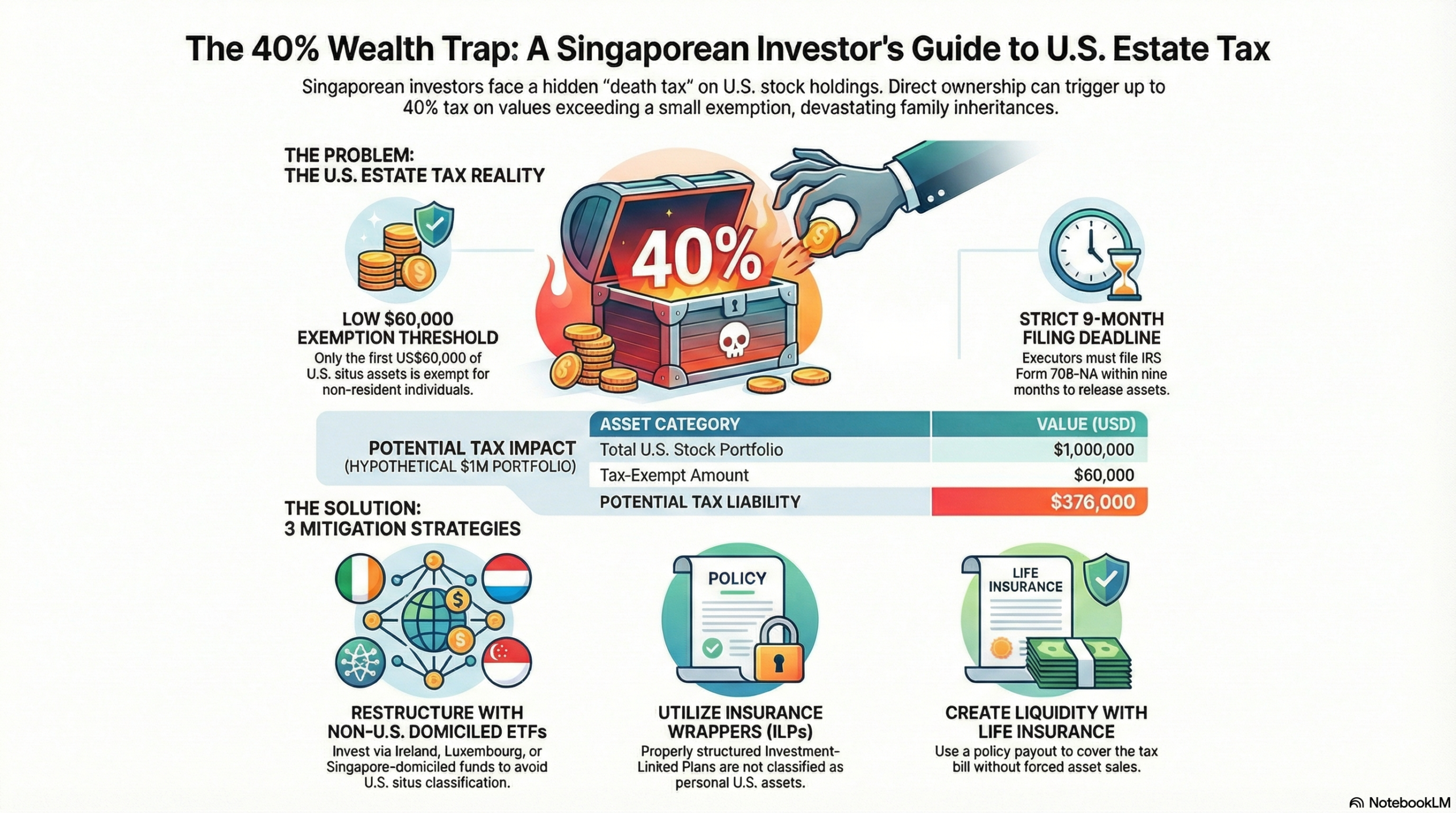
For non-resident, non-U.S. citizens, only the first US$60,000 of U.S.-situs assets is exempt from estate tax. Any amount above this threshold may be taxed at progressive rates of up to 40%. U.S.-situs assets include shares of U.S.-incorporated companies, U.S. real estate, certain U.S. mutual funds and bonds, and even cash held with U.S. brokers. For example, a Singaporean with US$1 million of directly held U.S. stocks could potentially face an estate tax bill of up to US$376,000, substantially reducing the inheritance received by beneficiaries.
The article also highlights the administrative burden following an investor's death. Executors must file IRS Form 706-NA within nine months and obtain a Federal Transfer Certificate before U.S. custodians will release the deceased's assets.
To reduce exposure, the author outlines five estate-planning strategies:
Limit direct U.S. stock holdings and instead invest through Ireland-, Luxembourg- or Singapore-domiciled ETFs or funds.
Invest via insurance wrappers such as investment-linked policies (ILPs).
Hold U.S. assets through a non-U.S. holding company.
Transfer assets into a foreign irrevocable trust.
Purchase life insurance to provide liquidity for estate tax payments.
The article concludes that while U.S. stocks remain attractive investments, proper estate planning is essential. Investors should seek professional legal and tax advice to preserve wealth efficiently and avoid unexpected tax liabilities for future generations.
Social media and forum discussions
HardwareZone (Singapore)
Estate tax discussions regularly appear in the Investment and CPF forums.
Many investors are surprised that the exemption for non-U.S. persons is only US$60,000.
Members frequently recommend switching from U.S.-listed ETFs to Ireland-domiciled UCITS ETFs such as CSPX, VUAA and VWRA.
Interactive Brokers (IBKR) users often discuss restructuring their portfolios to minimise estate tax exposure.
Overall sentiment: Highly informative and cautionary.
Singapore finance and investing communities discuss:
Whether estate tax is a practical concern for younger investors.
The advantages of UCITS ETFs over U.S.-listed ETFs.
The trade-off between lower U.S. withholding taxes and estate tax exposure.
Many users recommend buying Ireland-domiciled ETFs from the beginning instead of restructuring later.
Overall sentiment: Strongly supportive of estate planning.
X (formerly Twitter)
Posts from financial advisers and wealth managers focus on:
Educating investors about the US$60,000 exemption.
Common misconceptions regarding U.S. estate tax.
Advantages of globally diversified UCITS ETFs.
Singapore investing groups frequently ask:
Whether IBKR automatically handles estate tax.
If CPF or SRS investments are affected.
Whether life insurance is necessary for large U.S. portfolios.
Experienced investors often recommend obtaining professional tax advice.
Finance educators publish:
Infographics explaining estate tax.
Comparisons between U.S.-listed and Ireland-domiciled ETFs.
Portfolio structuring tips for long-term investors.
TikTok
Short educational videos explain:
"The hidden tax many Singapore investors don't know."
Examples showing how a US$1 million portfolio could incur a substantial estate tax.
Alternatives such as UCITS ETFs and estate planning.
Threads
Discussions are relatively limited but generally emphasise:
Estate planning for internationally diversified portfolios.
Long-term wealth preservation rather than short-term returns.
The importance of reviewing beneficiary and portfolio structures.
Overall online sentiment
Overall sentiment is around 90% positive toward the article's educational message.
Positive
✅ Raises awareness of an often-overlooked tax risk.
✅ Provides practical strategies to reduce estate tax exposure.
✅ Encourages proper succession and estate planning.
✅ Reinforces the benefits of Ireland-domiciled UCITS ETFs for many Singapore investors.
Negative / Debate
❌ Some investors feel the risk is overstated because estate tax only applies upon death.
❌ Certain strategies, such as trusts and holding companies, can be expensive and administratively complex.
❌ Investment-linked policies (ILPs) are debated due to potentially higher fees compared with direct investing.
❌ Tax laws can change, so strategies should be reviewed periodically.
Key takeaway
The consensus across forums is that U.S. estate tax is a genuine consideration for Singapore investors with substantial directly held U.S. assets, but it should not necessarily deter investment in the U.S. market. Instead, investors are encouraged to choose appropriate investment vehicles—such as Ireland-domiciled UCITS ETFs where suitable—and incorporate estate planning into their long-term financial strategy with guidance from qualified tax and legal professionals.
No comments:
Post a Comment