Source:
ChatGPT:
1. What the Mothership article says
Mothership — S'pore paying S'poreans to read for at least 15 minutes a day
The article, published 16 September 2026, explains Singapore's new ReadSG Challenge, launched by the National Library Board (NLB).
The basic idea:
Read for at least 15 minutes a day
Log the session through CrowdTaskSG
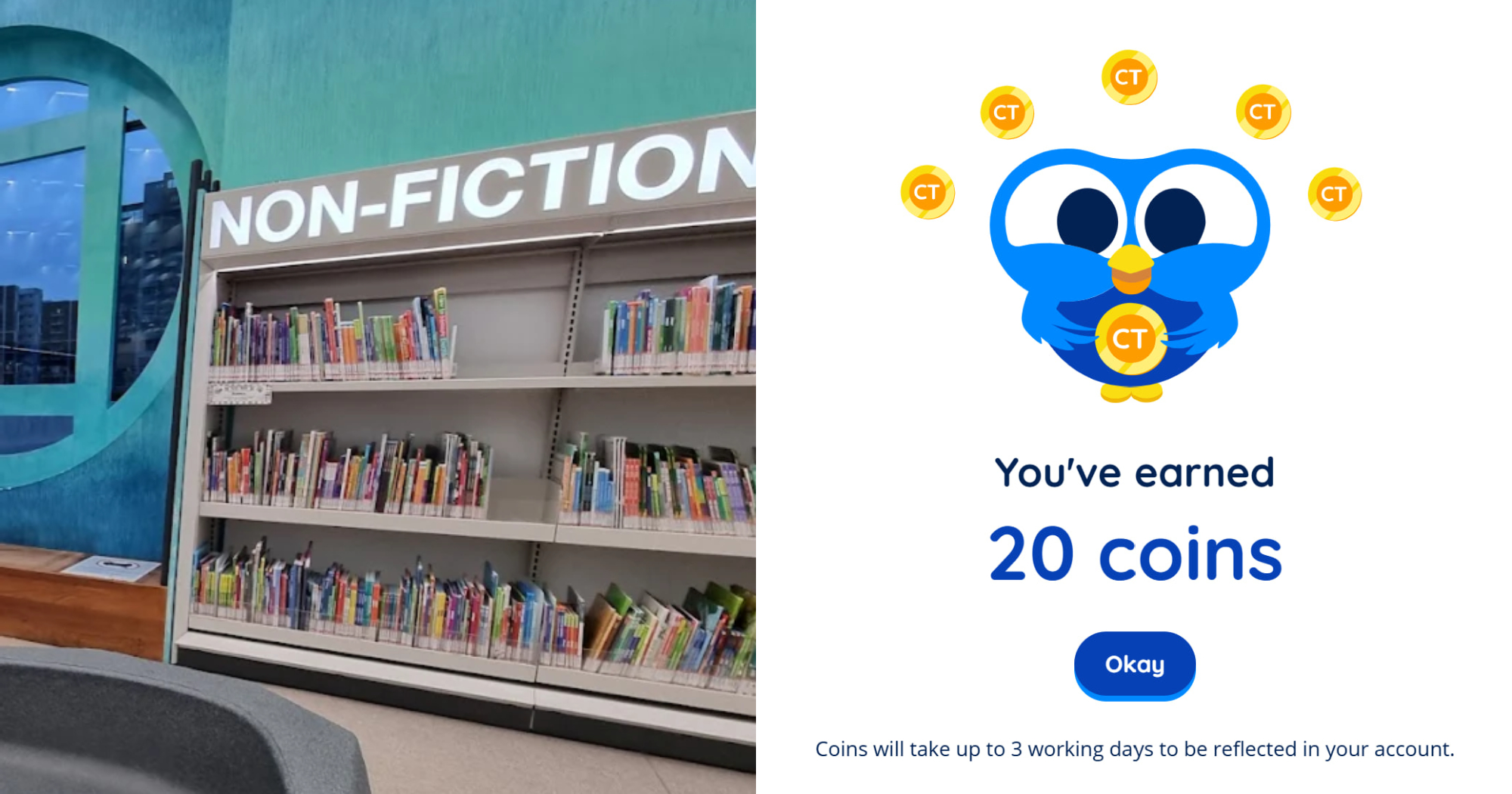
Earn 20 virtual coins
1,000 coins = S$1 in value
Only one session per day can be claimed
The programme is based on self-reporting — effectively an honour system
It is being piloted from 6 September to 31 December 2026. (Mothership)
The wider ReadSG initiative is a five-year national reading movement, intended to make reading a regular habit rather than simply run a one-off promotion. (The Straits Times)
The funny headline vs reality
The Mothership headline says:
“S'pore paying S'poreans to read”
Technically true, but the actual financial incentive is tiny.
15 minutes = 20 coins = S$0.02
So:
| Reading | Reward |
|---|---|
| 15 minutes | S$0.02 |
| 50 days | S$1 |
| 365 days | ~S$7.30 |
The Times similarly calculated that someone reading and logging 15 minutes every day for a year would receive about S$7.30. (The Times)
So this clearly isn't intended to be a money-making scheme.
The money is basically gamification.
2. What's actually interesting about ReadSG
The more important mechanism is habit formation.
NLB is effectively applying the same behavioural principle behind exercise challenges:
Don't tell people to become serious readers.
Tell them to do 15 minutes today.
The programme has:
daily streaks
XP
virtual coins
reading goals
reader-personality quizzes
event bonuses
lucky draws
This is deliberately designed to make reading behave more like a fitness challenge/mobile game than a traditional library programme. (The Straits Times)
NLB's rationale is that short-form digital content has made sustained attention harder, while long-form reading can help develop attention, critical thinking, imagination and empathy. (CNA Lifestyle)
3. The much more valuable reward: Kobo e-readers
This is something the Mothership article doesn't emphasise as much as some of the subsequent coverage.
The 20 coins aren't really the main attraction.
There are two lucky-draw rounds.
Round 1
Log 15 reading sessions by 7 October 2026 and you automatically enter the draw for:
8 × Kobo Clara Colour
Round 2
Accumulate 30 sessions by 30 November 2026 and you enter another draw for:
7 × Kobo Libra Colour
That's 15 Kobo readers in total. (MissLobang)
So from a Singaporean's perspective, the rational interpretation is:
Don't read for the 2 cents. Read for the habit, charity contribution and chance at the Kobo.
4. There's also a charity angle
This is arguably more meaningful than the coins.
From 6 September to 7 October, reading logged through ReadSG contributes towards Read for Good, NLB's charity reading initiative.
The target is:
7.5 million reading minutes → up to S$150,000
supporting programmes including kidsREAD, MINDS and Preschool Market. (The Straits Times)
So your 15 minutes aren't purely about your own reward.
The intended behavioural loop is:
You read → you log it → you get gamification → collective reading minutes accumulate → charity benefits.
5. What social media/forums are saying
Here's where it gets interesting.
I searched specifically for discussion around ReadSG, rather than simply searching for general Singapore reading discussions.
Reddit / HardwareZone / X
There isn't currently a huge, well-established discussion thread specifically about the Mothership article on Reddit or HardwareZone.
That's important because some social-media summaries can give the impression that there is a massive online backlash. I don't see evidence of that yet.
Instead, the discussion that has emerged is broadly along these lines:
Reaction 1 — “2 cents? LOL”
This is the obvious joke.
People focus on:
15 minutes → 20 coins → 2 cents
and compare it with the time spent logging the activity.
The “Singapore pays you to read” framing makes this particularly meme-friendly.
The more detailed Singapore deal/lobang coverage has essentially concluded that the cash component is trivial: reading for the entire 32-day September–October period produces only around S$0.64 in coins, plus the survey reward. (MissLobang)
Reaction 2 — “It's not really about the money”
A second group understands the behavioural objective.
The argument is basically:
Nobody is going to read for 15 minutes because they want 2 cents.
Instead, the reward provides a tiny nudge to establish a routine.
This interpretation is consistent with NLB's stated objective of developing sustainable reading habits through small, consistent actions. (The Straits Times)
Reaction 3 — “Why do we need to be paid to read?”
This is probably the most interesting criticism.
Some commentary questions whether reading should be treated like an activity that needs external rewards.
CNA published an opinion piece in August arguing that the experience of reading itself should be the reward, rather than relying too heavily on incentives. (CNA)
That's a legitimate behavioural-design question:
Does gamification create lifelong readers, or does it create people who participate only while rewards exist?
There isn't enough evidence yet to answer that.
6. Another criticism: what counts as “reading”?
This is where the programme is more flexible than people might assume.
ReadSG isn't simply:
“Read serious literary books.”
The challenge allows different types of reading material, including comics.
A Straits Times forum contributor specifically argued that comics should be embraced as an accessible starting point for reluctant readers because their visual and conversational format can make it easier to build momentum beyond 15 minutes. (The Straits Times)
That's actually consistent with the broader philosophy:
The objective is reading habit → not forcing everyone to read Tolstoy.
7. Social-media reaction has an international twist
Interestingly, Singapore's programme became an international curiosity.
CNN, The Guardian and international publications picked up the story because:
“Singapore pays citizens to read books.”
That headline travels extremely well.
The Times, for example, framed it as a programme designed to encourage people to put down phones and engage in sustained reading. (The Times)
PhilSTAR Life similarly highlighted the contrast between short-form digital content and long-form reading. (Philstar Life)
So Singapore's tiny 2-cent reward became much more newsworthy internationally than the monetary value would suggest.
8. What I think is the real story
If you strip away the clickbait:
The Mothership version
Singapore pays people to read.
The actual NLB strategy
Singapore is trying to turn reading into a daily habit using the same gamification techniques used for exercise and wellness programmes.
That's a much more interesting story.
The coins are almost irrelevant.
The actual experiment is:
Can 15 minutes + streaks + rewards + social participation + charity + lucky draws make people read more regularly?
And that's why the five-year duration matters much more than the 2 cents.
9. For Singapore parents, this is actually quite relevant
Given that ReadSG is designed for a broad population, I think the children/family angle may ultimately be more important than the “government paying adults to read” angle.
The programme is essentially trying to normalise:
📖 15 minutes of reading
📱 instead of 15 minutes of scrolling
And NLB is deliberately making the threshold very low.
The official ReadSG site describes 15 minutes as roughly the time between several MRT stops, waiting for a bus or having a morning coffee. (ReadSG)
That makes it much easier for parents to tell a child:
“Just read for 15 minutes.”
rather than:
“Go read a book.”
That's a meaningful difference in behavioural terms.
Bottom line
I'd summarise the whole discussion this way:
🟢 What ReadSG is:
A five-year NLB experiment to make reading a daily habit, using gamification.
💰 The 2-cent reward:
Almost meaningless financially. 50 days = S$1.
🎁 The real incentive:
Kobo lucky draws, event rewards and the gamification/streak system. (MissLobang)
❤️ The social-benefit component:
Logged reading contributes to Read for Good and potentially S$150,000 of support for reading-related causes. (The Straits Times)
😂 Main online joke:
“Singapore is paying people 2 cents to read.”
🤔 Main serious criticism:
Will extrinsic rewards actually produce lifelong readers, or merely participation while the rewards exist? CNA's commentary raises essentially this question. (CNA)
📚 Main positive argument:
15 minutes is deliberately achievable, and gamification may help people who have stopped reading rebuild the habit.
My read of the online reaction: the “2 cents LOL” angle is much more shareable than the actual policy objective, but there is also genuine interest in the habit-building and charity components. There isn't yet enough searchable Reddit/HWZ/X/Threads discussion to call it a broad backlash or consensus.
No comments:
Post a Comment