Source:
ChatGPT:
1. The article in a nutshell
The Straits Times' main finding is:
Singapore PC prices have jumped sharply in 2026 because AI data-centre construction is competing with ordinary consumers for memory, storage and graphics components.
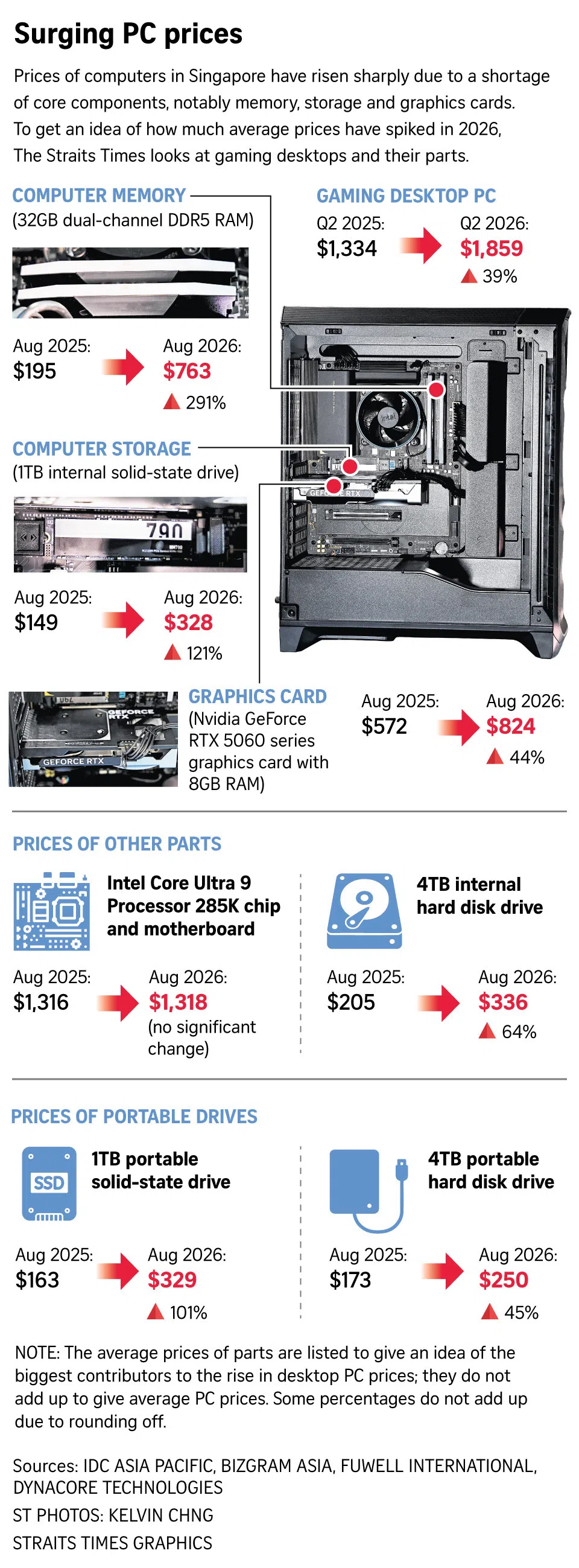
IDC data cited by ST shows average PC prices in Singapore rose by up to 40% year-on-year in Q2 2026. More importantly, the shortage is concentrated in components that consumers actually notice. (The Straits Times)
| Component / product | Approx. price change |
|---|---|
| Windows laptop | +26% |
| Normal desktop | +28% |
| Gaming desktop | +39% |
| Gaming laptop | +17% |
| 32GB DDR5 RAM | ~4× |
| 1TB SSD | +120% |
| 4TB HDD | +64% |
| RTX 5060 8GB | +44% |
The really shocking number is RAM.
A 32GB DDR5 dual-channel kit that averaged around S$195 in August 2025 was around S$763 one year later. (The Straits Times)
2. Why is AI causing PC prices to rise?
This is the important part.
It's not simply:
AI companies buy Nvidia GPUs → GPUs become expensive.
The supply-chain effect is much broader.
AI data centres require enormous amounts of:
HBM memory
conventional DRAM
SSD/NAND storage
GPUs
networking equipment
CPUs
power infrastructure
Memory manufacturers can make substantially more money selling components into the AI/data-centre market than the traditional consumer-PC market.
So manufacturers have an incentive to allocate scarce production capacity toward enterprise customers.
That leaves less supply for:
PCs → laptops → DIY upgrades → consumer SSDs → gaming PCs.
IDC's Ho Jin Wei describes this as manufacturers shifting memory production toward AI infrastructure because of the higher margins. (The Straits Times)
3. The problem isn't only RAM
This is where I think the article is particularly useful.
RAM
The biggest problem.
32GB DDR5: S$195 → S$763
That's approximately a 291% increase, or almost four times the old price. (The Straits Times)
SSD
1TB internal SSD:
S$149 → S$328
That's more than double.
HDD
4TB HDD:
S$205 → S$336
Still a substantial 64% increase.
GPU
RTX 5060 8GB:
S$572 → S$824
About 44% higher.
And ST says graphics-card manufacturers could raise prices further in the second half of 2026. (The Straits Times)
4. The really bad news: don't expect a quick recovery
This is probably the most important takeaway from the article.
IDC doesn't expect a meaningful return to cheaper PC hardware soon.
Its view is roughly:
2026 → expensive
2027 → still expensive
Late 2027 → some easing
2028+ → meaningful relief more likely
IDC therefore says meaningful PC-price relief is more likely a 2028-and-beyond story. (The Straits Times)
That is much more serious than a normal temporary shortage.
5. Singapore retailers are already hurting
This creates an unusual situation:
Components are becoming more expensive while retailers are selling fewer computers.
ST spoke to four Sim Lim Square retailers, who reported sales declines of around 20% to 80% compared with 2025. (The Straits Times)
One retailer selling new/refurbished PCs reportedly saw sales fall 80% and said it was becoming difficult to cover rent.
So retailers are being squeezed from both sides:
higher wholesale costs
customers refusing to buy
= terrible margins
6. HardwareZone reaction: "Yes, this is real"
The HardwareZone thread is particularly interesting because these aren't just people discussing an article — many are comparing it with what they personally paid for hardware.
The thread has already accumulated roughly 69 replies and 4,000 views. (HardwareZone Forums)
One of the recurring observations:
RAM and SSDs are at all-time highs.
Users specifically mention:
RTX 5060 previously around S$500 → now S$800+
RTX 5060 Ti 16GB → above S$1,200
RTX 5080 → approaching S$3,000
RTX 5090 → around S$7,000–8,000
HardwareZone users are therefore broadly agreeing with the article rather than dismissing it as sensationalist. (HardwareZone Forums)
7. The "I should have bought earlier" effect
This is probably the strongest sentiment across the forums.
People who bought PCs in 2025 are basically saying:
"I didn't realise how lucky I was."
One Reddit user bought a high-end PC in November 2025:
RTX 5090
Ryzen 9800X3D
64GB RAM
approximately S$6,700
They subsequently tried to replicate the same configuration and estimated it would now cost approximately S$9,800. (Reddit)
That's roughly a:
S$3,100 / 46% increase.
Another user said they bought a 5080 around the same period and similarly felt they had bought just before the surge. (Reddit)
8. Reddit: "Delay the upgrade"
This is where the discussion gets particularly interesting.
A June Reddit discussion asked how Singapore PC users were coping with the RAM crisis.
One user said they were considering repairing an old PC because reputable builders were already charging around S$1,500–2,000 for a decent build. (Reddit)
Another user said:
32GB DDR5 previously cost about S$300
now S$200 could barely buy 16GB DDR4
The conclusion from many commenters was essentially:
Don't upgrade unless you actually need to.
9. And now people are asking: should I buy before 11.11?
This is especially relevant for Singapore shoppers.
A Reddit thread posted just two days ago asks exactly that:
Buy a PC now or wait for 11.11?
The user was worried that Shopee sellers might raise prices before 11.11 and then offer artificial discounts.
One commenter said their prebuilt PC went from:
S$3,200 → S$3,900 in three months.
The general sentiment was:
Don't assume 11.11 will magically make PCs cheaper.
There may be promotions, but if the underlying hardware price keeps rising, a S$100–200 sale voucher isn't necessarily meaningful. (Reddit)
That's an important distinction.
10. Some users think the article is too simplistic
There is also a more technical counterargument.
It's not literally true that:
"AI companies are buying all the RAM."
The supply chain is more complicated.
AI accelerators primarily use HBM, while PCs use conventional DDR4/DDR5 DRAM.
However, these products ultimately compete for semiconductor manufacturing capacity and related resources.
A Reddit hardware discussion explains the economic incentive well: manufacturers can obtain much better margins from HBM/AI-related memory than conventional consumer DRAM. (Reddit)
So the real story is:
AI demand changes the economics of memory manufacturing.
That causes manufacturers to prioritise higher-margin products, tightening supply for consumer hardware.
11. Another major debate: "Is this just another AI bubble?"
This is probably the most interesting social-media argument.
Some Redditors believe the current pricing is unsustainable because AI infrastructure spending is becoming excessive.
The argument is:
AI investment explodes → memory demand explodes → manufacturers expand capacity → AI investment eventually slows → memory oversupply → prices crash.
There are already people comparing it to the dot-com bubble and waiting for the AI boom to burst. (Reddit)
But there's an equally strong counterargument:
AI demand isn't fake.
Even if some AI companies fail, the surviving hyperscalers may continue spending enormous amounts on infrastructure.
So nobody knows whether we're heading toward:
2000-style AI bust
or
a sustained structural increase in computing demand.
12. HardwareZone has a very Singaporean solution
One of the funniest themes in the discussion is basically:
"Just don't buy."
People are saying:
keep your existing PC
repair it
buy used
look at Carousell
postpone upgrades
hope the AI boom eventually ends
One HardwareZone user essentially said they were holding out until 2028 for hard-drive prices to normalise. (HardwareZone Forums)
Another said they were still using a 2016-era Asus laptop, having only upgraded its SSD/RAM.
That tells you how consumers are adapting: extending hardware lifespans.
13. Social media beyond Reddit/HWZ
I also searched for discussion on X, Facebook, Instagram, TikTok and Threads.
The important finding is that there isn't yet a huge independent conversation around the specific ST article.
The discussion is much more fragmented:
X
Mostly global discussion about:
RAM shortage
Nvidia GPU prices
AI infrastructure spending
"AI bubble" arguments
memory manufacturers prioritising HBM
More Singapore-focused sharing of the ST story, with discussion generally centred on:
"AI is making everything expensive."
Instagram/TikTok
Much less substantive discussion. The topic is more likely to appear as short-form PC-building/AI content rather than detailed analysis.
Threads
Similar situation — discussion exists around AI infrastructure and hardware inflation, but it hasn't generated anything close to the HardwareZone/Reddit level of technical discussion.
So if you're looking for actual Singapore consumer sentiment, I would weight:
HardwareZone + Reddit > Facebook > X > Threads/Instagram/TikTok
for this particular story.
14. The biggest takeaway
The article isn't really about "PCs becoming 40% more expensive."
The bigger story is:
AI infrastructure is beginning to compete directly with ordinary consumers for semiconductor manufacturing capacity.
And that affects much more than PCs.
The same supply-chain pressure can potentially flow into:
PCs → smartphones → SSDs → game consoles → networking equipment → servers → electronics.
This is why the story is particularly interesting given the current AI boom.
My overall reading of the situation
I'd rate the article's thesis as credible, but I'd separate three things:
🟢 Very real
Consumer RAM/SSD/GPU prices are already much higher.
The Singapore retail data and forum users independently corroborate this. (The Straits Times)
🟡 Likely to persist
Prices probably won't return quickly to 2025 levels.
The combination of AI infrastructure demand and manufacturers prioritising higher-margin products makes a rapid correction unlikely. IDC's 2028+ warning is therefore worth taking seriously. (The Straits Times)
🔴 Still uncertain
Whether today's prices will remain permanently high.
If AI investment eventually slows substantially, semiconductor capacity expands and consumer demand weakens, we could get another major hardware price correction.
And for an ordinary Singapore PC buyer...
My conclusion from the article + forums would be:
If your PC is working fine → don't upgrade simply because of FOMO.
If you genuinely need a new PC → don't assume waiting until 11.11 will produce a dramatically cheaper machine.
If you're buying high-end RAM/SSD/GPU → price-locking a good deal may be more valuable than chasing a small sale voucher.
If your existing PC can survive another 1–2 years → that's probably the cheapest strategy.
The irony is that AI is making AI-enabled services cheaper and more accessible while simultaneously making the hardware needed to run ordinary computing more expensive.
And the Singapore forum reaction is essentially: "Fine, then I'll keep using my old PC."
No comments:
Post a Comment