Labels

Lifestyle (450) Investing (400) Entertainment (304) Singapore (250) Technology (147) Rewards (136) Insights (115) Gaming (103) Equities (97) AI (89) Food (82) Data (79) U.S. (77) Sports (73) Crypto (72) Travel (65) Portfolio (55) News (49) Credit Card (38) Movies (35) Earnings (34) Football (34) Savings (34) Policies (27) Property (27) Tennis (25) Shows (24) Holidays (23) Promotions (19) Bonds (16) Toys (16) Malaysia (15) World (15) REITs (14) T-Bills (12) China (11) Apps (10) Healthcare (10) Referral (10) Currency (9) Anime (8) DeFi (8) Retirement (8) CPF (7) Cash Management (7) Security (6) ETFs (5) Miles (5) Shopping (5) Commodities (4) Robotics (4) Weird (4) platform (4) Cashback (3) Insurance (3) Japan (3) Blog (2) Reviews (2) Robo-Advisor (2) 1-For-1 (1) Asia (1) Australia (1) Banking (1) Funds Management (1) Futuristic (1) Government (1) Indonesia (1) Inflation (1) Interesting (1) Nerfs (1) SGD (1) SSB (1) Social (1) Thailand (1)

Tuesday, 15 September 2026

Investing Updates: S-Reits an ‘oasis of calm’ amid global bond yield surge: UOBKH


Source:


ChatGPT:


I checked the Business Times article and the broader Singapore REIT discussion on HardwareZone and Reddit, plus searches for X, Facebook, Instagram, TikTok and Threads. The article is very recent, so discussion of this exact piece is still limited; the more useful signal comes from the wider debate about S-REITs, bond yields, banks and interest rates.

1. The article in one sentence

UOB Kay Hian remains bullish on Singapore REITs because Singapore's relatively stable government-bond yields make domestically focused S-REITs more attractive while rising yields in the US, UK, Australia and other developed markets hurt REITs with overseas exposure. (The Business Times)

The key idea is not "all S-REITs are safe."

It is:

Singapore exposure = relatively defensive; overseas exposure = increasingly important risk factor.


2. Why UOBKH thinks Singapore is different

The biggest number in the article is the difference in 10-year government bond yields.

Country2026 YTD / current yield cited
πŸ‡ΈπŸ‡¬ Singapore2.36%
πŸ‡¨πŸ‡³ China~1.7%
πŸ‡―πŸ‡΅ Japan~2.9%
πŸ‡ΊπŸ‡Έ US~4.9%
πŸ‡¦πŸ‡Ί Australia~5.2%
πŸ‡¬πŸ‡§ UK~5.2%

Singapore's 10-year yield has increased only 24 bps this year, versus:

  • US: +63 bps

  • Japan: +82 bps

UOBKH therefore sees Singapore as relatively insulated from the global bond-yield shock. (The Business Times)


3. Why bond yields matter so much to REITs

This is the part that Singapore investors already understand very well.

REITs are effectively competing with bonds for income investors.

Suppose:

Government bond = 5%

and

REIT = 6%

The investor only gets an extra 1 percentage point for taking considerably more risk.

But if:

Government bond = 2.4%

and

REIT = 6%

the REIT's income premium becomes much more attractive.

That's why rising long-term bond yields generally put downward pressure on REIT valuations.

And this is also why the country where the REIT's properties are located matters.


4. The clever part of UOBKH's analysis

UOBKH has changed its valuation methodology.

Instead of treating every S-REIT as if it faces the same risk-free rate, it looks at the 10-year government bond yield of the countries where each REIT owns assets. (The Business Times)

That creates a much more nuanced picture.

A REIT with 90% Singapore assets

is effectively exposed to:

Singapore's ~2.36% risk-free rate.

A REIT with substantial US/Australia/UK assets

has to contend with:

~4.9–5.2% government bond yields.

That can materially affect its valuation.


5. The winners according to UOBKH

UOBKH particularly likes REITs with high Singapore exposure.

It left target prices for these largely unchanged:

CapitaLand Integrated Commercial Trust

Singapore exposure: 93%

Target: S$3.06

Frasers Centrepoint Trust

Singapore exposure: 100%

Target: S$2.93

Lendlease Global Commercial REIT

Singapore exposure: 91%

Target: S$0.79

The important point is that these REITs don't have to absorb the full impact of the much higher overseas bond yields. (The Business Times)


6. The losers: overseas-heavy REITs

This is where the report becomes much more interesting.

CapitaLand Ascott Trust

UOBKH cut its target price by 27.5%.

Why?

40.4% of its assets are in Australia, UK and US.

Frasers Logistics & Commercial Trust

Target cut:

−27.8%

because:

  • Australia: 46.8%

  • UK: 9.8%

of assets. (The Business Times)

That's a huge difference.


7. Two more interesting examples

Mapletree Industrial Trust

Target price cut 15.9% → S$1.74

because its US data-centre portfolio represents 46.5% of assets.

That's particularly interesting because MIT is often viewed as a high-quality Singapore REIT.

But UOBKH is saying:

quality doesn't eliminate duration/geographic risk.

Mapletree Logistics Trust

Target cut 10.9% → S$1.15.

It has substantial exposure to:

  • Australia

  • Malaysia

  • South Korea

Again, the message is that geographic exposure now matters more than simply saying "this is an S-REIT." (The Business Times)


8. UOBKH's actual preferred picks

Despite the bearish adjustments to some names, UOBKH isn't bearish on the entire sector.

Its BUY calls include:

  • CICT — target S$3.06

  • Mapletree Pan Asia Commercial Trust — S$1.71

  • NTT DC REIT — US$1.29

  • UI Boustead REIT — S$1.16 (The Business Times)

So the thesis is really:

BUY the right REITs rather than indiscriminately buying the whole sector.


9. The bigger macro argument

UOBKH believes global bond yields could remain structurally high because of worsening government finances.

πŸ‡ΊπŸ‡Έ US

  • Budget deficit around 6% of GDP

  • Annual interest costs above US$1 trillion

  • Government debt projected at 142% of GDP by 2031

πŸ‡―πŸ‡΅ Japan

  • Debt around 233% of GDP

  • Ageing population

  • Increasing debt-servicing costs

Meanwhile, Singapore has:

  • persistent budget surpluses

  • substantial investment returns

  • strong fiscal credibility

UOBKH says Singapore's recurring net investment returns averaged S$25.1 billion a year from 2021–2025, helping fund around one-fifth of annual government operating expenditure. (The Business Times)

That helps explain why Singapore's bond market is behaving differently.


10. The social/forum reaction is more complicated

This is where I think the article needs some healthy scepticism.

HardwareZone

The long-running General S-REITs Discussion Thread has historically been extremely focused on US Treasury yields.

One recurring observation is essentially:

UST 10-year/30-year yields spike → S-REITs get hammered.

Another poster explicitly noted that the previous S-REIT crashes were associated with spikes in long-duration US Treasury yields. (HardwareZone Forums)

But HardwareZone investors also recognise that interest rates aren't the only variable.

Debt refinancing, tenant quality, DPU growth, rights issues and dilution all matter.

An older discussion, for example, highlighted that high rates don't merely affect valuation — they eventually increase refinancing costs, which can hit DPU. (HardwareZone Forums)

That is an important distinction from UOBKH's analysis.


11. Reddit is much more sceptical

The recent SingaporeFI discussion following DBS's similar bullish REIT call is revealing.

One commenter basically dismissed S-REITs because of NAV erosion.

Another asked the obvious question:

Why accept roughly 2% additional dividend yield and potentially little capital appreciation when Singapore banks are yielding ~4% and have appreciated much more?

That Reddit discussion received significant engagement, with the "banks are better" argument receiving more support than the bullish REIT argument. (Reddit)

This is important because it shows that retail investors aren't automatically convinced by a 6%+ REIT yield.


12. The "6.2% yield" argument has a catch

Just recently, DBS made a similar argument that S-REITs yield around 6.2%, versus approximately 4% for DBS/OCBC/UOB. (The Business Times)

So on the surface:

S-REITs → 6.2%

Banks → 4%

Looks like REITs are the obvious bargain.

But investors on Reddit pushed back.

Their argument is:

Dividend yield ≠ total return.

A REIT can give you:

6.2% dividend

but lose:

5% in share price

while a bank gives:

4% dividend

and gains:

15% in share price.

Therefore, comparing dividend yields alone can be misleading.


13. There's actually a bigger Singapore investment debate here

The market has undergone a major shift.

For years:

REITs = income

Banks = cyclical/value

But after the enormous bank rally:

Banks = capital gains + growing dividends

while:

REITs = high yield + depressed valuation

So the question investors are now asking is:

Is the REIT discount finally too large?

That is exactly why both DBS and UOBKH are increasingly positive on selected REITs.


14. What I think the article gets right

🟒 Very convincing: Singapore vs overseas exposure

This is probably the strongest point.

A REIT with 90–100% Singapore assets is fundamentally different from one with half its portfolio in Australia/US/UK.

The bond-yield environment now makes that difference more important.

🟒 Singapore's fiscal position is a genuine advantage

Singapore's unusually strong fiscal credibility gives its government bond market a structural advantage.

That makes the 2.36% Singapore 10-year yield much less threatening to local REITs than a 5%+ government yield elsewhere.

🟒 REIT valuations remain interesting

With S-REIT yields around 6%+, there is now a substantial income premium over Singapore government bonds and local banks. (The Business Times)


15. What I would be cautious about

πŸ”΄ "Oasis of calm" is slightly too optimistic

Singapore REITs are still equities.

If global risk-off sentiment becomes severe, S-REITs can absolutely fall even if Singapore bond yields remain stable.

πŸ”΄ Refinancing still matters

Even a Singapore REIT can have debt that needs refinancing at higher rates.

So you should examine:

aggregate leverage + interest coverage + debt maturity schedule + fixed-rate percentage.

πŸ”΄ DPU growth matters

A 6.5% yield isn't necessarily attractive if DPU is falling 3% every year.

πŸ”΄ Currency risk

A Singapore-listed REIT can still own Australian/US/UK properties.

So:

SGX listing ≠ Singapore economic exposure.

That's perhaps the most important lesson from this article.


16. What this means for your CapitaLand Ascendas REIT exposure

This article is particularly relevant if you're still holding your CapitaLand Ascendas REIT (A-REIT) position.

I would not interpret the article as simply "sell overseas REITs."

Instead, I'd look at A-REIT through three lenses:

1. Singapore exposure

How much of its asset base/cash flow is genuinely Singapore-linked?

2. Overseas exposure

How much is exposed to Australia, US/Europe and their higher long-term interest rates?

3. Debt/refinancing

When does the debt mature, and at what cost can it realistically be refinanced?

That's much more useful than simply looking at the headline dividend yield.


17. My overall conclusion

I'd summarise the article as:

UOBKH thinks the global bond-yield problem is becoming a geographic problem for S-REITs, not simply an interest-rate problem.

That is a subtle but important distinction.

The hierarchy now looks something like:

Best positioned
→ Singapore-heavy REITs

Middle
→ Asia-heavy REITs

More vulnerable
→ Australia/UK/US-heavy REITs

And the social/forum discussion adds another layer:

"6% yield is attractive, but banks have already demonstrated much stronger total returns."

So I wouldn't blindly buy S-REITs simply because UOBKH says they're an "oasis of calm."

But Singapore-heavy REITs trading at depressed valuations with sustainable DPU and manageable debt are becoming increasingly interesting, especially after the huge run-up in the local banks.

One particularly interesting development is that DBS and UOBKH are now independently making broadly similar arguments for S-REITs, despite the sector having lagged the banks. DBS sees the average S-REIT yield at about 6.2% versus ~4% for the three local banks, while UOBKH's newer analysis says the geographic composition of each REIT is now critical. (The Business Times)
Technology Updates: Singapore PC prices surge as growing AI infrastructure competes for components


Source:


ChatGPT:


I checked the Straits Times article and the discussion that has developed around it, especially on HardwareZone and Reddit. The article is getting a surprisingly strong reaction because the price increases are not theoretical — Singapore buyers are reporting that they are already seeing them.

1. The article in a nutshell

The Straits Times' main finding is:

Singapore PC prices have jumped sharply in 2026 because AI data-centre construction is competing with ordinary consumers for memory, storage and graphics components.

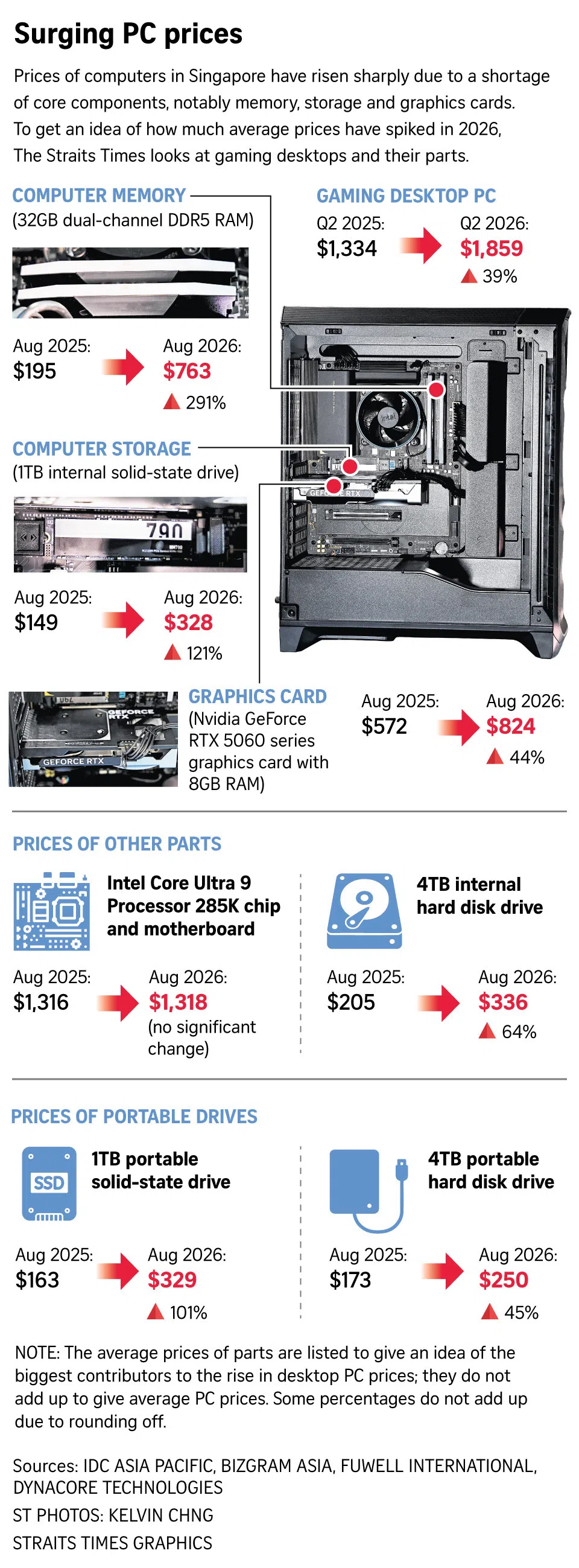
IDC data cited by ST shows average PC prices in Singapore rose by up to 40% year-on-year in Q2 2026. More importantly, the shortage is concentrated in components that consumers actually notice. (The Straits Times)

Component / productApprox. price change
Windows laptop+26%
Normal desktop+28%
Gaming desktop+39%
Gaming laptop+17%
32GB DDR5 RAM~4×
1TB SSD+120%
4TB HDD+64%
RTX 5060 8GB+44%

The really shocking number is RAM.

A 32GB DDR5 dual-channel kit that averaged around S$195 in August 2025 was around S$763 one year later. (The Straits Times)


2. Why is AI causing PC prices to rise?

This is the important part.

It's not simply:

AI companies buy Nvidia GPUs → GPUs become expensive.

The supply-chain effect is much broader.

AI data centres require enormous amounts of:

  • HBM memory

  • conventional DRAM

  • SSD/NAND storage

  • GPUs

  • networking equipment

  • CPUs

  • power infrastructure

Memory manufacturers can make substantially more money selling components into the AI/data-centre market than the traditional consumer-PC market.

So manufacturers have an incentive to allocate scarce production capacity toward enterprise customers.

That leaves less supply for:

PCs → laptops → DIY upgrades → consumer SSDs → gaming PCs.

IDC's Ho Jin Wei describes this as manufacturers shifting memory production toward AI infrastructure because of the higher margins. (The Straits Times)


3. The problem isn't only RAM

This is where I think the article is particularly useful.

RAM

The biggest problem.

32GB DDR5: S$195 → S$763

That's approximately a 291% increase, or almost four times the old price. (The Straits Times)

SSD

1TB internal SSD:

S$149 → S$328

That's more than double.

HDD

4TB HDD:

S$205 → S$336

Still a substantial 64% increase.

GPU

RTX 5060 8GB:

S$572 → S$824

About 44% higher.

And ST says graphics-card manufacturers could raise prices further in the second half of 2026. (The Straits Times)


4. The really bad news: don't expect a quick recovery

This is probably the most important takeaway from the article.

IDC doesn't expect a meaningful return to cheaper PC hardware soon.

Its view is roughly:

2026 → expensive

2027 → still expensive

Late 2027 → some easing

2028+ → meaningful relief more likely

IDC therefore says meaningful PC-price relief is more likely a 2028-and-beyond story. (The Straits Times)

That is much more serious than a normal temporary shortage.


5. Singapore retailers are already hurting

This creates an unusual situation:

Components are becoming more expensive while retailers are selling fewer computers.

ST spoke to four Sim Lim Square retailers, who reported sales declines of around 20% to 80% compared with 2025. (The Straits Times)

One retailer selling new/refurbished PCs reportedly saw sales fall 80% and said it was becoming difficult to cover rent.

So retailers are being squeezed from both sides:

higher wholesale costs

customers refusing to buy

= terrible margins


6. HardwareZone reaction: "Yes, this is real"

The HardwareZone thread is particularly interesting because these aren't just people discussing an article — many are comparing it with what they personally paid for hardware.

The thread has already accumulated roughly 69 replies and 4,000 views. (HardwareZone Forums)

One of the recurring observations:

RAM and SSDs are at all-time highs.

Users specifically mention:

  • RTX 5060 previously around S$500 → now S$800+

  • RTX 5060 Ti 16GB → above S$1,200

  • RTX 5080 → approaching S$3,000

  • RTX 5090 → around S$7,000–8,000

HardwareZone users are therefore broadly agreeing with the article rather than dismissing it as sensationalist. (HardwareZone Forums)


7. The "I should have bought earlier" effect

This is probably the strongest sentiment across the forums.

People who bought PCs in 2025 are basically saying:

"I didn't realise how lucky I was."

One Reddit user bought a high-end PC in November 2025:

  • RTX 5090

  • Ryzen 9800X3D

  • 64GB RAM

  • approximately S$6,700

They subsequently tried to replicate the same configuration and estimated it would now cost approximately S$9,800. (Reddit)

That's roughly a:

S$3,100 / 46% increase.

Another user said they bought a 5080 around the same period and similarly felt they had bought just before the surge. (Reddit)


8. Reddit: "Delay the upgrade"

This is where the discussion gets particularly interesting.

A June Reddit discussion asked how Singapore PC users were coping with the RAM crisis.

One user said they were considering repairing an old PC because reputable builders were already charging around S$1,500–2,000 for a decent build. (Reddit)

Another user said:

  • 32GB DDR5 previously cost about S$300

  • now S$200 could barely buy 16GB DDR4

The conclusion from many commenters was essentially:

Don't upgrade unless you actually need to.


9. And now people are asking: should I buy before 11.11?

This is especially relevant for Singapore shoppers.

A Reddit thread posted just two days ago asks exactly that:

Buy a PC now or wait for 11.11?

The user was worried that Shopee sellers might raise prices before 11.11 and then offer artificial discounts.

One commenter said their prebuilt PC went from:

S$3,200 → S$3,900 in three months.

The general sentiment was:

Don't assume 11.11 will magically make PCs cheaper.

There may be promotions, but if the underlying hardware price keeps rising, a S$100–200 sale voucher isn't necessarily meaningful. (Reddit)

That's an important distinction.


10. Some users think the article is too simplistic

There is also a more technical counterargument.

It's not literally true that:

"AI companies are buying all the RAM."

The supply chain is more complicated.

AI accelerators primarily use HBM, while PCs use conventional DDR4/DDR5 DRAM.

However, these products ultimately compete for semiconductor manufacturing capacity and related resources.

A Reddit hardware discussion explains the economic incentive well: manufacturers can obtain much better margins from HBM/AI-related memory than conventional consumer DRAM. (Reddit)

So the real story is:

AI demand changes the economics of memory manufacturing.

That causes manufacturers to prioritise higher-margin products, tightening supply for consumer hardware.


11. Another major debate: "Is this just another AI bubble?"

This is probably the most interesting social-media argument.

Some Redditors believe the current pricing is unsustainable because AI infrastructure spending is becoming excessive.

The argument is:

AI investment explodes → memory demand explodes → manufacturers expand capacity → AI investment eventually slows → memory oversupply → prices crash.

There are already people comparing it to the dot-com bubble and waiting for the AI boom to burst. (Reddit)

But there's an equally strong counterargument:

AI demand isn't fake.

Even if some AI companies fail, the surviving hyperscalers may continue spending enormous amounts on infrastructure.

So nobody knows whether we're heading toward:

2000-style AI bust

or

a sustained structural increase in computing demand.


12. HardwareZone has a very Singaporean solution

One of the funniest themes in the discussion is basically:

"Just don't buy."

People are saying:

  • keep your existing PC

  • repair it

  • buy used

  • look at Carousell

  • postpone upgrades

  • hope the AI boom eventually ends

One HardwareZone user essentially said they were holding out until 2028 for hard-drive prices to normalise. (HardwareZone Forums)

Another said they were still using a 2016-era Asus laptop, having only upgraded its SSD/RAM.

That tells you how consumers are adapting: extending hardware lifespans.


13. Social media beyond Reddit/HWZ

I also searched for discussion on X, Facebook, Instagram, TikTok and Threads.

The important finding is that there isn't yet a huge independent conversation around the specific ST article.

The discussion is much more fragmented:

X

Mostly global discussion about:

  • RAM shortage

  • Nvidia GPU prices

  • AI infrastructure spending

  • "AI bubble" arguments

  • memory manufacturers prioritising HBM

Facebook

More Singapore-focused sharing of the ST story, with discussion generally centred on:

"AI is making everything expensive."

Instagram/TikTok

Much less substantive discussion. The topic is more likely to appear as short-form PC-building/AI content rather than detailed analysis.

Threads

Similar situation — discussion exists around AI infrastructure and hardware inflation, but it hasn't generated anything close to the HardwareZone/Reddit level of technical discussion.

So if you're looking for actual Singapore consumer sentiment, I would weight:

HardwareZone + Reddit > Facebook > X > Threads/Instagram/TikTok

for this particular story.


14. The biggest takeaway

The article isn't really about "PCs becoming 40% more expensive."

The bigger story is:

AI infrastructure is beginning to compete directly with ordinary consumers for semiconductor manufacturing capacity.

And that affects much more than PCs.

The same supply-chain pressure can potentially flow into:

PCs → smartphones → SSDs → game consoles → networking equipment → servers → electronics.

This is why the story is particularly interesting given the current AI boom.


My overall reading of the situation

I'd rate the article's thesis as credible, but I'd separate three things:

🟒 Very real

Consumer RAM/SSD/GPU prices are already much higher.

The Singapore retail data and forum users independently corroborate this. (The Straits Times)

🟑 Likely to persist

Prices probably won't return quickly to 2025 levels.

The combination of AI infrastructure demand and manufacturers prioritising higher-margin products makes a rapid correction unlikely. IDC's 2028+ warning is therefore worth taking seriously. (The Straits Times)

πŸ”΄ Still uncertain

Whether today's prices will remain permanently high.

If AI investment eventually slows substantially, semiconductor capacity expands and consumer demand weakens, we could get another major hardware price correction.


And for an ordinary Singapore PC buyer...

My conclusion from the article + forums would be:

If your PC is working fine → don't upgrade simply because of FOMO.

If you genuinely need a new PC → don't assume waiting until 11.11 will produce a dramatically cheaper machine.

If you're buying high-end RAM/SSD/GPU → price-locking a good deal may be more valuable than chasing a small sale voucher.

If your existing PC can survive another 1–2 years → that's probably the cheapest strategy.

The irony is that AI is making AI-enabled services cheaper and more accessible while simultaneously making the hardware needed to run ordinary computing more expensive.

And the Singapore forum reaction is essentially: "Fine, then I'll keep using my old PC."

Investing Updates: Time for the CPFIS to get in on the Next 50 act


Source:


ChatGPT:


I read the Business Times article and checked the current discussion around CPFIS, the new Q50 ETF and Singapore small/mid-cap investing across HardwareZone and Reddit, plus searches for X, Facebook, Instagram, Threads and TikTok. The social-media footprint for this specific article is still quite small because it was published only on Sep 14.

1. What the Business Times article is saying

The central argument by former SGX senior managing director Chew Sutat is:

CPF Investment Scheme (CPFIS) should be expanded to include the new Singapore Next 50 Active ETF, because CPF money could help channel capital into Singapore's neglected small- and mid-cap companies.

The argument comes against the backdrop of a dramatic SGX revival.

  • The STI has risen about 52% in 19 months, from around 3,800 to above 5,800.

  • SGX daily securities trading value has risen from roughly S$1 billion to more than S$2 billion for much of 2026.

  • But the gains have been heavily concentrated in the big banks.

  • DBS, OCBC and UOB now account for about 58% of the STI. (The Business Times)

So the author's concern is essentially:

Singapore's stock market is recovering — but the recovery is disproportionately benefiting the biggest companies rather than the small/mid-cap segment.

Why the Next 50 matters

The iEdge Singapore Next 50 represents the 50 largest companies after the STI's 30 constituents.

It is considerably more diversified than the STI and has a much larger REIT component:

  • Next 50: roughly 45% REITs

  • STI: roughly 11% REITs

  • Next 50 dividend yield: approximately 5.5–5.8%

The problem is that the Next 50 hasn't performed nearly as well as the bank-heavy STI this year. Higher rates have helped banks while hurting REITs. (The Business Times)

But the author points out that a liquidity-weighted Next 50 has done considerably better, helped by companies such as iFAST and UMS and, more recently, AEM.


2. The proposed solution: Q50

This is where the article gets interesting.

The CGS Fullgoal Singapore Next 50 Active ETF (Q50) launched on SGX on September 3.

It invests primarily in the Next 50 but is actively managed, rather than simply mechanically tracking the index.

The structure is:

80%+ → Next 50 companies

Up to 20% → other SGX-listed opportunities

It holds approximately 30–50 stocks and is rebalanced monthly. (The Business Times)

The ETF uses a six-factor quantitative approach covering things such as:

  • valuation

  • growth

  • earnings surprises

  • analyst sentiment

  • earnings quality

  • market/liquidity factors

So instead of blindly buying all 50 companies, the manager attempts to select the more attractive opportunities.

It raised S$28.8 million initially, which the BT author sees as a reasonable starting point. (The Business Times)


3. Why CPFIS is the controversial part

The author's proposal is not simply "let CPF investors buy more stocks."

He is suggesting that new Singapore-focused ETFs like Q50 should potentially be automatically eligible for CPFIS, because they could help accomplish the government's broader objective of developing Singapore's equity market.

The logic is:

CPF money → Q50 → diversified SMID exposure → more demand/liquidity → better analyst coverage → more institutional interest → stronger SGX ecosystem.

That is essentially a policy proposal, rather than an announcement that CPFIS eligibility has already been granted.

This distinction is important.

The article says the Next Act is "perhaps enabling" new local ETFs to be automatically included in CPFIS — it isn't saying the government has decided to do so. (The Business Times)


4. The biggest issue: is CPF money actually suitable for this?

This is where the online discussion becomes more sceptical.

The strongest counterargument is:

CPF is retirement money.

CPF SA/OA returns are relatively predictable, while equities aren't.

HardwareZone discussions repeatedly show this tension.

One recent CPFIS discussion had a user essentially questioning why CPF should be exposed to investment losses at all, with another poster arguing that a large proportion of CPFIS investors lose money. (HardwareZone Forums)

Another HardwareZone CPFIS discussion had users questioning whether it was worth giving up the guaranteed CPF return for potentially only a modest additional investment return. (HardwareZone Forums)

That's a very different mindset from the BT article.


5. Reddit's reaction: much more practical

The SingaporeFI Reddit discussions aren't yet centred specifically on this BT article, but they provide a useful picture of how financially sophisticated CPF investors are actually thinking.

The recurring themes are:

"Why bother taking the risk?"

A Reddit discussion on CPFIS investing shows people choosing Amundi MSCI World as a long-term CPF investment precisely because they want broad diversification rather than individual Singapore stocks. (Reddit)

Another discussion explicitly describes a CPF portfolio centred on Amundi World, while using IBKR for broader and more specialised investments. (Reddit)

That is quite revealing.

For many CPF investors, the attraction of CPFIS is:

CPF → global diversified fund

rather than:

CPF → Singapore small/mid-cap stocks.


6. Q50 itself has attracted scepticism

There was already a BT opinion piece on September 3 titled "Sceptics of the Q50 are asking the right questions about Singapore's newest ETF."

The concerns included:

  • REIT concentration

  • fees

  • no long live track record

  • whether Singapore actually needs another equity ETF (The Business Times)

That's important because the CPFIS proposal adds another layer of risk.

You're effectively asking:

"Should CPF investors be allowed to put retirement money into a brand-new actively managed ETF with limited live performance history?"

That's a much harder question than simply asking whether Q50 is interesting.


7. HardwareZone discussion

The most relevant HardwareZone discussion currently is actually about Q50 itself rather than this exact BT article.

The discussion describes Q50 as a way to diversify beyond the bank-heavy STI, with healthcare, technology, materials and energy companies represented more heavily than in the STI. (HardwareZone Forums)

This fits the BT thesis quite closely:

STI = banks + large blue chips

versus

Q50 = the next tier of Singapore companies.

But the broader CPFIS discussions on HardwareZone remain fairly conservative.

The recurring attitude is essentially:

CPF is the safe-money bucket; if you want to take equity risk, use cash.

That's not universal, but it is a significant sentiment.


8. What about X, Facebook, Instagram, TikTok and Threads?

I specifically searched for the article/Q50/CPFIS combination across those platforms.

My finding:

There isn't yet a meaningful viral social-media debate around this particular BT article.

That's unsurprising because the article is only about a day old.

The conversation is instead fragmented around:

  • Singapore stock-market rally

  • Q50 ETF

  • CPFIS

  • Amundi CPF investments

  • Singapore small/mid-cap stocks

  • REITs

  • CPF retirement investing

So I would not claim that "social media is strongly supporting" or "strongly opposing" the BT proposal yet.

The most substantive public discussions I found are currently on HardwareZone and Reddit, rather than X/Instagram/TikTok/Threads.


9. The interesting contradiction

This is actually the most interesting part of the article.

The government wants to strengthen Singapore's equity market.

But CPF investors are probably among the most risk-sensitive investors in Singapore.

So the policy dilemma becomes:

Option A — Keep CPF conservative

CPF remains primarily:

4%+ relatively safe retirement money → global diversified investment only where appropriate

Advantages:

  • protects retirement capital

  • avoids government being seen as directing CPF into local equities

  • less concentration risk

Disadvantage:

  • CPF money doesn't help develop SGX's smaller companies.

Option B — Open CPFIS to Q50

CPF investors gain access to:

50 additional Singapore companies → potentially higher returns + dividends

while Q50 provides diversification compared with buying individual small caps.

But:

CPF investors could lose money.

And because Q50 is new, we don't yet know how well its active-management strategy will work in actual market conditions.


10. My take on the article

I think the author's diagnosis is stronger than his proposed solution.

I agree with the diagnosis:

Singapore's stock-market revival is currently too heavily concentrated in the banks.

The fact that DBS/OCBC/UOB make up roughly 58% of the STI is a legitimate diversification concern. (The Business Times)

And Singapore's small/mid-cap companies genuinely need:

liquidity → research → institutional investors → products → retail participation.

Q50 could help with that.

But I'm less convinced CPFIS is the answer.

The better argument would be:

Make Q50 widely accessible to ordinary investors first, prove its liquidity and track record, then consider CPFIS eligibility.

That's more defensible than immediately directing CPF money into it.


11. What this means for you personally

Given your own CPF investing interest, I think the important distinction is CPF vs your ordinary investment portfolio.

If Q50 becomes CPFIS-eligible, I'd view it as:

Potential satellite allocation, not a replacement for your global CPF portfolio.

For example, conceptually:

Core CPF
→ global diversified equity fund

Satellite CPF
→ Q50 / Singapore equities

rather than:

100% CPF → Singapore Next 50

because Q50 is still essentially a Singapore-specific equity bet, with substantial REIT exposure.

And there's another point particularly worth watching: the Q50 ETF is actively managed and relatively new. Its initial S$28.8m size is encouraging, but it's nowhere near enough evidence to conclude that it will outperform the STI over a full market cycle. (The Business Times)


Bottom line

I'd summarise the whole article in one sentence:

Singapore has successfully revived the STI, but the revival has mainly made the big banks bigger; the author wants CPF money to help push that success down into the next 50 Singapore companies through Q50.

And the social/forum reaction so far is basically:

"Interesting idea, but don't confuse developing SGX with maximising CPF retirement returns."

That is the key debate.

The most compelling part of the proposal is diversification beyond the STI banks. The weakest part is assuming that CPF retirement money should necessarily be the capital used to solve Singapore's small-cap liquidity problem.

For context, the CPF Board currently requires CPFIS investments to go through approved product/provider arrangements and tracks CPFIS holdings and transactions; eligibility is therefore a regulatory question, not something Q50 automatically gets simply because it is listed on SGX. (Central Provident Fund)

Monday, 14 September 2026

Investing Updates: What to Expect in the Week Ahead (Fed Interest Rate Decision)


Source:


ChatGPT:


I checked the Moomoo article and cross-checked the week-ahead setup against current market coverage and investor discussions on Reddit, HardwareZone and other publicly searchable social platforms. The Moomoo page itself is currently timing out, so I reconstructed the article's key points from its indexed version and corroborating sources. (Moomoo)

Moomoo article — key summary

The big story this week is the US Federal Reserve meeting on 15–16 September. The market has rapidly shifted from expecting rates to remain unchanged to pricing in a 25-bp Fed hike, largely because inflation remains sticky and oil prices have surged.

The backdrop is unusual:

  • August CPI was 3.4% YoY, with core CPI at 2.4%.

  • Core CPI increased 0.3% MoM, keeping inflation concerns alive.

  • Oil has risen sharply amid Middle East tensions, creating another inflationary impulse.

  • Treasury yields have moved sharply higher, with the 10-year approaching 5%.

  • Markets are increasingly expecting the Fed to raise rates to roughly 3.75%–4.00%. (Reuters)

The bigger question isn't just whether the Fed hikes. Investors will be watching Kevin Warsh's press conference and the new projections/dot plot for clues about whether this is a one-off hike or the beginning of another tightening cycle.

Other things to watch

The week also includes:

  • US retail sales

  • Housing starts/building permits

  • Initial jobless claims

  • Industrial production

  • Philadelphia Fed manufacturing

  • Earnings from companies including Trip.com and Lennar. (Liquid)

  • The Bank of Japan is also expected to be hawkish, potentially adding pressure to global bond markets.


What investors are discussing online

1. Reddit: surprisingly hawkish

Reddit sentiment has clearly shifted.

One highly upvoted r/stocks discussion argues that the hot inflation data has made the Fed meeting a major test for Warsh. The concern is that if Warsh repeatedly talks tough on inflation but then doesn't hike, the Fed could damage its credibility. (Reddit)

Another r/Economics discussion had hundreds of upvotes around the idea that we're suddenly looking at the first Fed hike in years, despite investors having spent much of 2026 expecting cuts. One commenter summed up the shift as:

“6 months ago everyone was pricing in cuts for 2026”

The consensus there is increasingly that inflation + energy prices have changed the story. (Reddit)

2. But Reddit is also divided

There's an interesting counterargument:

The hike may already be priced in.

Some traders are arguing that if the Fed actually hikes 25 bps, stocks could rise rather than fall, because the uncertainty disappears.

One of the more interesting discussions points out that the market's reaction to CPI was counterintuitive: rate-hike odds jumped substantially, yet the Nasdaq and S&P 500 rallied. The explanation was that headline CPI wasn't dramatically worse than expected and oil subsequently fell. (Reddit)

Another popular discussion makes the even more interesting argument that:

A Fed hold could actually be more bearish than a hike.

Why? If the Fed refuses to hike despite inflation and rising yields, bond investors may conclude that the Fed is behind the curve. That could push long-term Treasury yields even higher. (Reddit)

That's an important distinction.


HardwareZone / Singapore investor angle

The Singapore discussion is much more practical.

On HardwareZone, investors have already been discussing the possibility of higher US rates feeding into Singapore borrowing costs. One discussion essentially boils down to:

Fed hike → Singapore rates probably don't fall as quickly → mortgages/borrowing costs remain higher.

But another poster correctly pushes back that the Fed's September move isn't guaranteed to translate one-for-one into Singapore rates and that 25 bps isn't necessarily a major shock. (HardwareZone Forums)

There's also a broader Singapore-investor theme around bonds:

Higher-for-longer is becoming a bigger concern for bond investors.

A recent HardwareZone investment discussion has users talking about global bond funds continuing to struggle and considering fixed deposits/T-bills instead. (HardwareZone Forums)

This is particularly relevant for Singapore investors because the usual assumption that "Fed cuts = bond prices go up" has been badly disrupted.


The really important market signal: bonds

I think this is the part of the Moomoo article that deserves the most attention.

The story isn't simply:

Fed hike → stocks fall.

The more important chain is:

Oil ↑ → inflation expectations ↑ → Fed expected to hike → Treasury yields ↑ → valuation pressure on stocks ↑

The 10-year Treasury yield has been approaching 5%, while longer-duration bonds have been under significant pressure. (Reuters)

And there's a strange twist:

A Fed hike could actually stabilise the bond market.

If investors believe the Fed is finally serious about fighting inflation, a 25-bp hike could reassure bond investors and prevent yields from rising further.

Conversely:

Fed holds → market questions Fed credibility → Treasury yields rise further → stocks potentially sell off harder.

That is why this meeting is considerably more complicated than a normal rate decision.


What about US stocks?

The online mood is cautious but not outright bearish.

The S&P 500 is still up strongly for 2026, supported by corporate earnings. Reuters notes that the S&P 500 remains around 12% higher for the year despite the recent pullback. (Reuters)

That creates an interesting setup:

ScenarioLikely initial reaction
25-bp hike + dovish Warsh🟒 Potential relief rally
25-bp hike + neutral guidance🟑 Volatile
25-bp hike + hawkish WarshπŸ”΄ Stocks/yields pressured
No hike + dovish🟒 Stocks rally initially
No hike + hawkishπŸ”΄ Potentially worst outcome

The last scenario is the one I'd be most worried about.

If the Fed holds but says inflation is still too high and more hikes may be necessary, the market gets neither lower rates nor reassurance.


My take for a Singapore investor

For someone with a diversified long-term portfolio, I wouldn't interpret this as "sell everything before Wednesday."

Instead, I'd see it as a regime-change risk.

The market has gone from:

"When will the Fed cut?"

to:

"Could the Fed need to hike again?"

That's a major change.

And there are three things I'd watch more closely than the actual 25-bp decision:

1. 10-year Treasury yield
If it breaks decisively above 5%, equity valuations could come under more pressure.

2. Warsh's language
Is this a one-off inflation response, or does he see further tightening as necessary?

3. Oil prices
If oil remains around/above US$100, inflation could become much harder for the Fed to ignore. The latest geopolitical developments have already pushed Brent above US$100. (Reuters)

Bottom line

Moomoo's article is essentially warning that this is a pivotal macro week, but the social-media discussion is more nuanced than simply "Fed hike = stock market crash."

The most interesting emerging consensus is:

The hike itself may already be priced in. What really matters is whether Warsh signals that this is the beginning of a new tightening cycle.

For Singapore investors holding US ETFs, global equities, REITs, bonds or T-bills, I'd pay particularly close attention to US 10-year yields rather than the Fed headline alone.

Sports Updates: Aaaand that’s a wrap on Grand Slam tennis for 2026 🎬

Source: