Source:
ChatGPT:
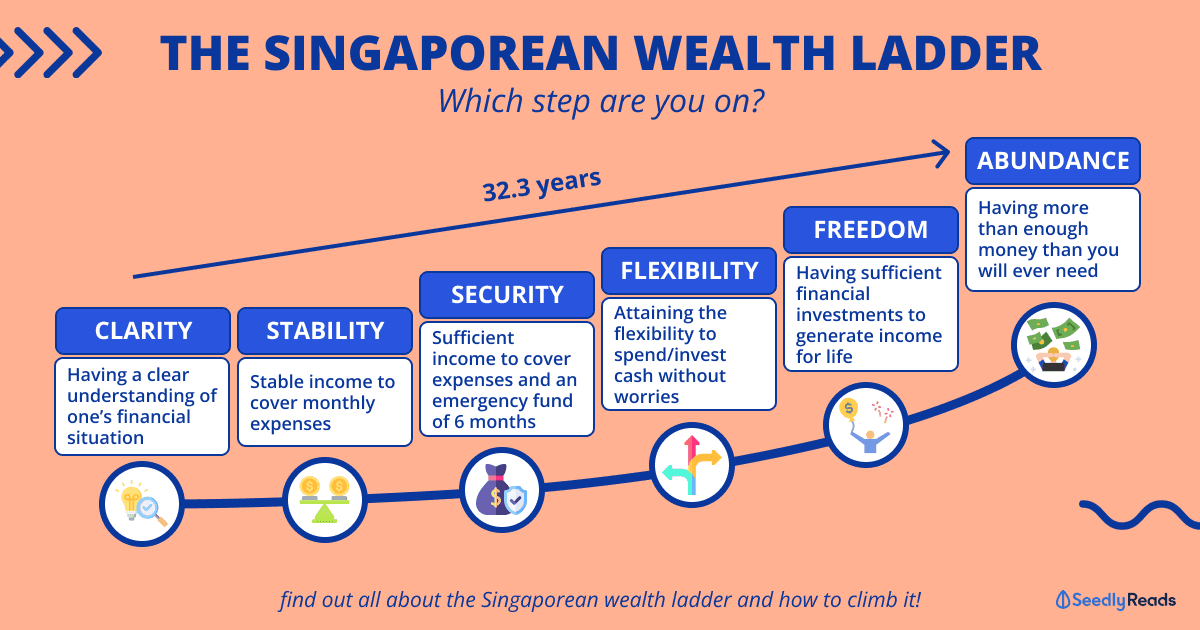
The article begins by explaining net worth, calculated as total assets minus total liabilities. Assets include cash, investments, CPF savings and property equity, while liabilities cover housing, education and personal loans. However, Seedly stresses that net worth alone can be misleading because wealth tied up in property may not provide sufficient liquidity during emergencies.
The six stages are:
Financial Clarity – understanding income, spending, debts and financial goals.
Financial Stability – consistently covering expenses while building a three- to six-month emergency fund.
Financial Security – saving and investing regularly after establishing a strong financial foundation.
Financial Flexibility – accumulating enough liquid assets to support up to one year of living expenses without employment income.
Financial Freedom – generating sustainable passive income that covers ongoing living costs.
Financial Abundance – having more wealth than required, allowing greater focus on philanthropy, family support and legacy planning.
The article also notes there is no official net worth benchmark by age in Singapore because financial circumstances differ widely. Instead, individuals should measure success by their ability to meet obligations, withstand financial setbacks and achieve personal goals. According to research cited, progressing from financial stability to financial abundance takes an average of 32.3 years, although individual journeys vary considerably. The article concludes that wealth is ultimately about gaining greater control over life choices rather than competing with others.
Social media and forum discussions
HardwareZone (Singapore)
The article sparked moderate discussion in finance and CPF-related threads.
Many members debated whether net worth remains a meaningful measure when a large proportion comes from HDB property appreciation.
Users generally agreed that financial flexibility is a more useful milestone than chasing a specific net worth.
Some criticised wealth ladders as overly simplistic because they do not fully account for family obligations or caregiving responsibilities.
Overall sentiment: Positive with healthy debate.
Singapore-focused finance communities discussed:
Whether financial freedom should be measured by passive income or annual spending.
The importance of emergency funds before investing.
Users appreciated that the framework emphasises behaviour instead of comparing wealth by age.
Some argued that CPF balances should be treated differently from liquid investments when calculating financial independence.
Overall sentiment: Mostly positive.
X (formerly Twitter)
Personal finance creators shared:
Infographics summarising the six wealth stages.
Discussions about why net worth alone can be misleading.
Encouragement for younger investors to focus on financial clarity rather than comparing themselves with others.
Singapore finance groups mainly discussed:
Which stage they currently identify with.
Whether property equity should count as accessible wealth.
Practical budgeting tips for moving from financial stability to financial security.
Finance influencers posted:
Carousel graphics explaining each wealth ladder stage.
Budgeting, investing and CPF educational content.
Motivational posts encouraging long-term financial discipline.
TikTok
Creators produced short videos covering:
"Which wealth stage are you?"
Common mistakes when calculating net worth.
The importance of emergency savings before investing.
Threads
Discussion volume remains relatively small.
Posts generally highlight:
Building wealth as a gradual journey.
Measuring success based on financial security rather than social comparison.
Appreciation for the framework's realistic approach.
Overall online sentiment
Overall sentiment is around 85–90% positive.
Positive
✅ Easy-to-understand framework for financial planning.
✅ Focuses on financial behaviours instead of age or salary.
✅ Encourages emergency savings, investing and long-term planning.
✅ Highlights that wealth includes flexibility and peace of mind, not just net worth.
Negative
❌ Some believe the framework oversimplifies complex financial situations.
❌ Property-heavy net worth may overstate actual financial security.
❌ Passive income targets can vary greatly depending on lifestyle and retirement goals.
❌ The estimated 32-year journey may feel discouraging for younger investors.
The general consensus across forums is that the Wealth Ladder serves as a useful personal finance roadmap rather than a strict benchmark, helping Singaporeans focus on sustainable financial progress instead of comparing themselves with others.
No comments:
Post a Comment