Source:
ChatGPT:
2026 results
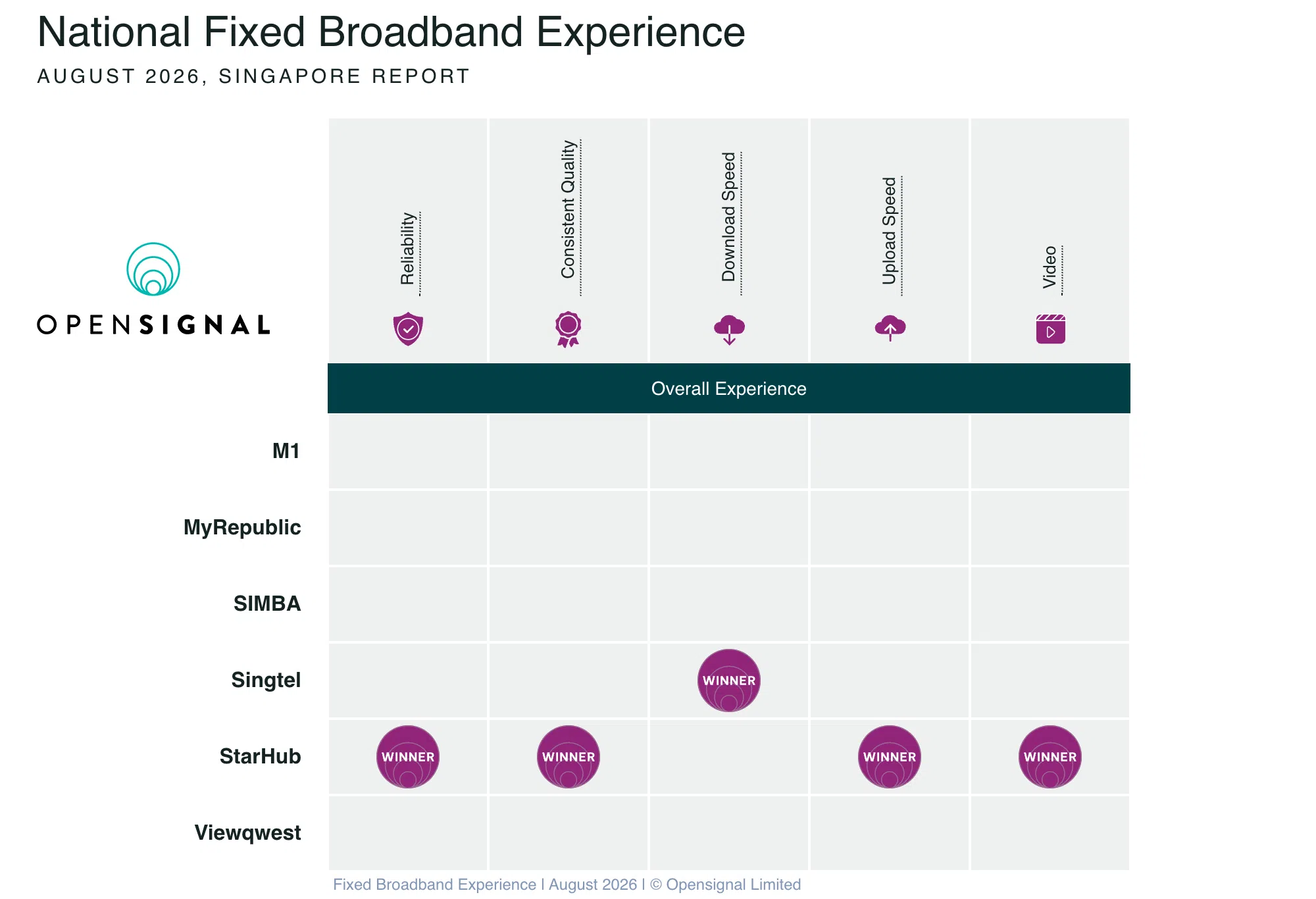
| Category | Winner | Result |
|---|---|---|
| Reliability | StarHub | 754 |
| Consistent Quality | StarHub | 86.0% |
| Download Speed | Singtel | 248.0 Mbps |
| Upload Speed | StarHub | 111.0 Mbps |
| Video Experience | StarHub | 76.4 |
StarHub's biggest strength is therefore not maximum advertised fibre speed, but everyday usability. Its 86% Consistent Quality score incorporates download/upload performance, latency, jitter, packet loss and time-to-first-byte, while Reliability measures how consistently users get a usable connection. (HardwareZone Singapore)
This matters for households simultaneously running Netflix/YouTube, gaming, Teams/Zoom calls, cloud backups and multiple connected devices. A 10Gbps plan is of limited value if Wi-Fi performance, latency or reliability is poor.
Singtel has made the biggest speed improvement
Singtel is the only provider preventing a StarHub clean sweep. Its 248Mbps average Download Speed narrowly beats StarHub's 242.1Mbps and MyRepublic's 214.9Mbps. More importantly, Singtel has jumped from 145.8Mbps in 2024 to 248Mbps in 2026—roughly a 70% improvement.
StarHub also improved substantially, from 153.9Mbps to 242.1Mbps.
The figures are real-world Wi-Fi measurements, not the maximum speeds printed on fibre-plan advertisements. (HardwareZone Singapore)
The MyRepublic twist
Perhaps the most interesting part of the story is MyRepublic.
In 2024, MyRepublic was the broadband performance leader, winning Download Speed and Peak Download Speed and sharing Consistent Quality and Video Experience with ViewQwest.
Today, MyRepublic has lost its former dominance—and StarHub now owns the MyRepublic broadband business outright.
So there is an ironic element to the comparison: the company that has apparently become Singapore's broadband performance leader has also acquired the provider that used to dominate these rankings.
What Singaporeans are saying online
The online reaction is more nuanced than simply “StarHub is now the best ISP.”
Reddit: real-world experience matters more than awards
Recent r/askSingapore discussions show consumers comparing ISPs primarily on price, stability, gaming latency, customer service and router/mesh performance, rather than benchmark awards.
One recent discussion had a StarHub user saying the connection was generally fine but sometimes laggy for overseas gaming, while considering MyRepublic because it was cheaper. (Reddit)
Another recent discussion about home Wi-Fi showed how aggressively priced Singapore broadband has become. Users reported plans from roughly S$28–S$35/month, with StarHub and Singtel often costing more but being perceived as safer choices for reliability. (Reddit)
This highlights an important limitation of the Opensignal ranking: an average national result doesn't guarantee that a particular household will have the best experience.
Your building, ONT, router, Wi-Fi placement, mesh system, device capabilities and overseas routing can all matter.
MyRepublic still has a loyal following
There is also considerable nostalgia among experienced broadband users for MyRepublic's previous reputation, particularly among gamers.
Older Reddit discussions contain users saying they switched from StarHub to MyRepublic because of poor console download performance, while praising MyRepublic's gaming speeds and low ping. (Reddit)
That makes MyRepublic's current third-place Download Speed position particularly interesting: its performance hasn't necessarily collapsed—it has simply been overtaken by competitors that improved faster.
HardwareZone
HardwareZone's own broadband discussions tend to focus heavily on actual user experience rather than Opensignal rankings—especially pricing, router hardware, gaming latency, static IP, customer service and contract terms.
That is particularly relevant because StarHub's ownership of MyRepublic creates an interesting dilemma. Reddit users discussing the acquisition questioned whether MyRepublic would retain features that attracted enthusiasts, particularly static IP and gamer-oriented services. (Reddit)
X, Facebook, Instagram, TikTok and Threads
I found plenty of general Singapore broadband/telco content, but not enough substantive, independently verifiable discussion specifically reacting to this Aug. 26 Opensignal article on X, Facebook, Instagram, TikTok or Threads to claim a reliable sentiment consensus.
The strongest usable discussion remains on Reddit and HardwareZone, where users tend to challenge the idea that a benchmark automatically tells you which ISP you should buy.
The bigger story: faster broadband, fewer independent players
There are actually two stories hidden in the article.
Story 1: Singapore broadband has improved dramatically.
Singtel's measured download performance has risen around 70% in two years, while StarHub's increased around 57%. Upload, reliability and consistency have also improved across the market.
Story 2: the market is consolidating.
StarHub's four-category dominance becomes more interesting because MyRepublic—the former performance champion—is now part of StarHub. Meanwhile, the wider market is seeing consolidation and increasingly aggressive pricing.
Interestingly, another 2026 benchmark from nPerf reaches a somewhat different conclusion: it ranks MyRepublic first overall, including the best measured download and upload speeds. (nPerf)
That doesn't necessarily mean one report is wrong. The methodologies, measurement periods and user samples differ. It is a useful reminder that there is no single definitive “best ISP” for every Singapore household.
My take
The headline “StarHub wins four of five” is impressive, but I wouldn't use it alone to decide which broadband plan to buy.
For a typical family, I'd prioritise:
Reliability/consistency
Good Wi-Fi 6/7 mesh coverage
Price after promotional period
Gaming/overseas latency if relevant
Customer service
Maximum advertised bandwidth
The really encouraging part is that Singapore's actual broadband experience appears to be getting substantially better even as advertised plans race from 1Gbps to 10Gbps.
The less encouraging part is that the competitive landscape is becoming more concentrated. StarHub winning four categories while owning MyRepublic means consumers should watch not just performance—but whether consolidation eventually reduces differentiation and competition.
Bottom line: 🏆 StarHub is the 2026 Opensignal performance winner, but “best ISP” remains highly dependent on your location, usage and price.
No comments:
Post a Comment