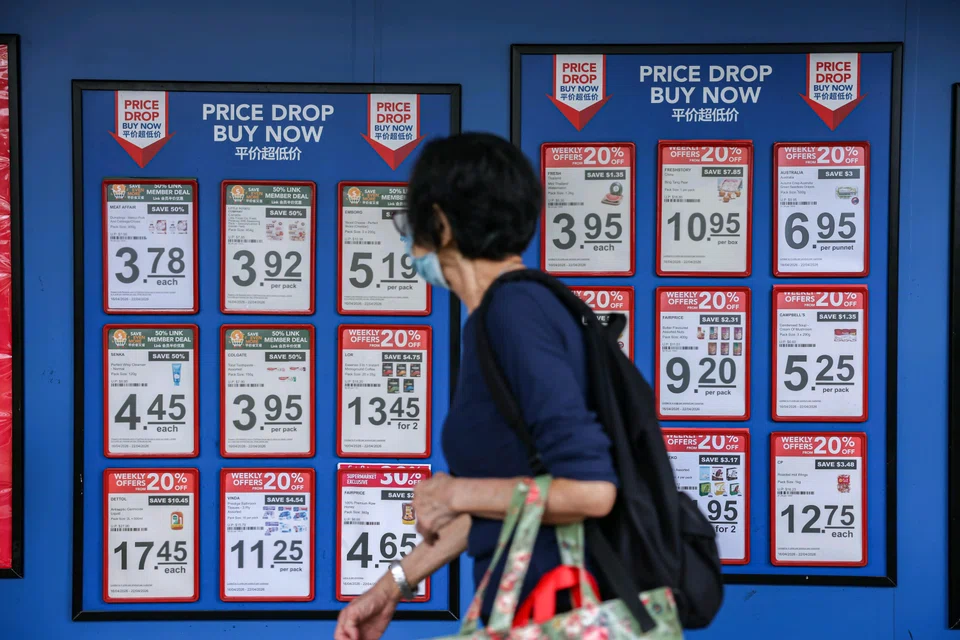
Source:
ChatGPT:
Singapore's core inflation rose to 2.2% year-on-year in August 2026, up from 2.0% in July, marking the highest level in almost two years. Headline CPI inflation also increased slightly, from 2.2% to 2.3%. The August core reading was broadly in line with economists' expectations. (The Business Times)
The interesting part is what this means for MAS's October monetary-policy decision: economists are not uniformly expecting another tightening, despite inflation moving higher.
What pushed prices up?
| Component | August | July | What happened |
|---|---|---|---|
| MAS core inflation | 2.2% | 2.0% | Highest since Sep 2024 |
| Headline CPI | 2.3% | 2.2% | Rose slightly |
| Services | 2.0% | 1.7% | Airfares & point-to-point transport rose faster |
| Retail & other goods | 1.8% | 1.4% | Clothing, footwear & personal care |
| Food | 2.3% | 2.2% | Mainly higher food-service prices |
| Accommodation | 0.8% | 0.8% | Unchanged |
(Ministry of Trade and Industry)
One particularly notable number was airfares, which jumped 12.9%, the biggest increase in almost four years. Transport costs also accelerated. (The Business Times)
🏦 The big question: Will MAS tighten again?
This is where the article gets interesting.
MAS had already tightened its exchange-rate policy in April and again in July, increasing the slope of the S$NEER policy band. Singapore uses the exchange rate rather than an interest-rate target as its primary monetary-policy tool.
So the question is whether August's inflation warrants another move in October.
The analysts are split
Standard Chartered:
Sees continuing price pressures and relatively resilient economic growth — suggesting inflation risks haven't disappeared. (The Business Times)
DBS:
Senior economist Chua Han Teng's assessment was essentially that inflation has firmed but isn't accelerating dramatically. This distinction is important: 2.2% is higher, but the monthly increase doesn't necessarily indicate runaway inflation. (The Business Times)
Barclays:
Argues the August numbers may actually be more benign than MAS anticipated when it tightened in July. If economic growth is generating less inflation than expected, there is less reason for MAS to tighten aggressively again. (The Business Times)
As a result, the article describes the October decision as essentially a close call between holding policy and making a small additional tightening. (The Business Times)
🛢️ The bigger risk may actually be oil
This is probably the most important part of the article beyond the headline 2.2%.
Singapore imports virtually all of its energy, so higher global oil prices eventually feed into Singapore's electricity, transport and other costs.
The article notes that electricity and gas tariffs and transport fares have already been affected by higher global energy prices. (The Business Times)
RHB economists identified energy prices as the clearest upside risk to Singapore's inflation outlook.
They also flagged a second risk:
Food prices.
Extreme weather, including the potential effects of El Niño on agricultural production, could push global food commodity prices higher into 2027. (The Business Times)
MAS and MTI consequently expect inflation to remain relatively elevated before moderating more noticeably around mid-2027. (ICIS)
🤔 Why MAS may not react aggressively
There's an important counterargument.
Singapore's economy has been growing strongly, but the labour market has shown some softness.
That matters because inflation caused by strong domestic demand is more concerning for MAS than inflation caused by temporary external factors such as oil.
DBS's view is that Singapore's current inflation isn't primarily coming from excessive domestic demand. The article describes demand-pull pressures as restrained despite strong economic growth. (The Business Times)
So you essentially have two forces:
Inflationary pressure ↑
Oil/energy
Airfares
Transport
Food
Imported costs
versus
Reasons not to tighten aggressively
Labour market softness
Some inflation is externally driven
Growth-to-inflation transmission appears relatively mild
Inflation remains within MAS/MTI's forecast range
📊 The official forecast hasn't changed
Despite the August increase, MAS and MTI are still forecasting 2026 average inflation of 1.5%–2.5% for both core and headline inflation. (Ministry of Trade and Industry)
That's an important distinction.
2.2% in August doesn't mean MAS has suddenly abandoned its inflation forecast.
The authorities expect core inflation to remain elevated into 2027 before moderating more clearly around mid-2027. (ICIS)
🗣️ What are Singaporeans discussing online?
I searched for discussion around the 23 September inflation release, including Reddit and HardwareZone, as well as indexed discussion on the other platforms you listed.
The discussion is noticeably less developed than for things like COE, GST or interest rates. I couldn't find enough directly attributable, current posts on X, Facebook, Instagram, TikTok or Threads to claim there is a meaningful consensus there.
Reddit / HardwareZone
The broader Singapore discussions tend to focus on something the official CPI numbers don't completely capture:
"Official inflation is 2.2%, but my personal cost of living feels much higher."
That is a recurring theme in Singapore inflation discussions.
HardwareZone discussions also tend to focus on real purchasing power, rather than the headline CPI number. One long-running investment/retirement discussion, for example, highlights concerns that living expenses have risen faster than incomes since the pandemic and that housing costs add to household pressure. (HardwareZone Forums)
Another long-running HWZ discussion about Singapore CPI makes an interesting point: some users pay more attention to month-to-month inflation than year-on-year inflation because YoY numbers incorporate prices from 12 months ago. (HardwareZone Forums)
That distinction is relevant here because August's core inflation was +0.3% month-on-month, which is meaningful but doesn't by itself indicate an accelerating inflation spiral. (Ministry of Trade and Industry)
💰 What does this mean for ordinary Singaporeans?
The 2.2% number can sound relatively harmless.
But look at where the increases are happening:
✈️ Air travel
🚕 Point-to-point transport
🍜 Food services
👕 Clothing
👟 Footwear
🧴 Personal care
⚡ Electricity/gas
These are expenses that households actually encounter.
And energy is particularly important because oil prices can have second-round effects — transport becomes more expensive, electricity costs rise, logistics costs rise, and businesses can subsequently pass some of those costs to consumers. (The Business Times)
🧠 My overall reading of the article
The headline "core inflation hits 2.2%" sounds more alarming than the underlying economic picture actually is.
There are three separate messages:
1. Inflation is clearly rising
Three consecutive months of increases and 2.2% core inflation means the disinflation story has temporarily stalled. (The Business Times)
2. But it isn't yet runaway inflation
The increase was expected, remains within the government's 1.5%–2.5% forecast range, and some economists see the latest data as relatively benign. (The Business Times)
3. Oil is the wildcard
If energy prices remain elevated, the current 2.2% could become more persistent because energy can feed into transport, utilities, food and other imported goods. (The Business Times)
So the key number I'd watch isn't just September's CPI. It's whether the next few months show continued broad-based price increases after the energy shock passes through.
For your own household/financial planning, this also means that cash/T-bill/SSB returns should be compared against actual household inflation rather than simply assuming the 2.2% headline is representative of your personal expenses. The official CPI is an average basket, while a household spending heavily on food, transport, utilities or travel can experience a different effective inflation rate.
No comments:
Post a Comment